
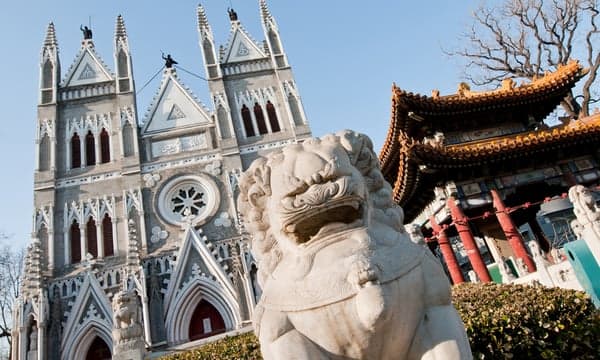
Christianity in China: How the CCP Frames the World's Largest Faith as a Threat
For billions of people worldwide, Christianity is a source of comfort, community, and moral grounding. For the Chinese Communist Party, however, certain foundational beliefs of that same faith have been reframed as dangerous, subversive, and cult-like. In a move that has drawn sharp condemnation from human rights organizations and religious freedom advocates around the globe, the CCP has systematically applied China's anti-cult legislation to suppress Christian practice — targeting churches, pastors, worshippers, and even the private reading of scripture.
Understanding what is happening to Christianity in China requires looking beyond surface-level headlines. The suppression is not incidental or the result of local misunderstandings. It reflects a deliberate ideological and policy decision made at the highest levels of the Chinese government, one with profound consequences for the estimated 97 million Christians living in China today.
How China Defines a "Cult" — and Why Christianity Fits the Label
China's legal framework around religious groups is built around a concept known as xie jiao — often translated as "evil cult" or "heterodox teaching." The term has historically been applied to groups the Party considers threats to social stability or state authority, most famously Falun Gong. But in recent years, enforcement of xie jiao laws has expanded dramatically, and Christianity has increasingly fallen within its scope.
The CCP's concern with Christianity is not simply about scale, although the religion's rapid growth in China over the past four decades has undeniably alarmed Party officials. The deeper issue is theological. Core tenets of the Christian faith — the authority of scripture over the authority of the state, allegiance to God above allegiance to a political party, the concept of a divine moral law that supersedes human law — are viewed by the Party as inherently incompatible with CCP supremacy.
In practice, this means that churches which refuse to subordinate their teaching to Party-approved doctrine can be, and increasingly are, classified as cult organizations under Chinese law. The consequences of that classification range from forced closure and property seizure to criminal prosecution and imprisonment.
The State-Approved Church vs. the Underground Church
China does technically permit Christian worship — but only within a tightly controlled system. The Three-Self Patriotic Movement (TSPM) is the state-sanctioned Protestant church, and the Chinese Patriotic Catholic Association serves a similar function for Catholics. Both operate under direct government supervision, with sermons, teachings, and even hymn selections subject to official review and censorship.
Churches that operate outside this framework — often called "house churches" or "underground churches" — have faced escalating pressure. Since 2018, when President Xi Jinping intensified the broader "Sinicization of religion" campaign, raids on unregistered churches have surged. Crosses have been torn down from church buildings. Bibles have been confiscated. Children under 18 have been legally barred from receiving religious education in many regions.
One of the most high-profile cases involved Early Rain Covenant Church in Chengdu, one of China's most prominent house churches. In December 2018, authorities detained hundreds of its members and arrested its pastor, Wang Yi, who was subsequently sentenced to nine years in prison on charges that included "inciting subversion of state power" — charges that critics around the world described as transparently politically motivated.
Sinicization: Rewriting Christianity to Serve the Party
Beyond outright suppression, the CCP has pursued a parallel strategy: not simply silencing Christianity, but reshaping it. The Sinicization of religion policy demands that all religious practice in China align with "Chinese characteristics" — which in reality means alignment with CCP ideology and the personal authority of Xi Jinping.
This has led to deeply troubling reports of churches being required to display portraits of Xi Jinping alongside or in place of religious imagery, of hymns being rewritten to include political messaging, and of theological seminaries being required to teach that Christian doctrine must be interpreted through a Marxist lens. The goal, as Party documents have made explicit, is to ensure that no religion in China commands a loyalty that competes with loyalty to the Party.
International Reaction and the Broader Stakes
The international response has been significant, though critics argue it has fallen far short of what the situation demands. The United States Commission on International Religious Freedom (USCIRF) has repeatedly designated China as a "Country of Particular Concern." Religious liberty organizations including Open Doors, ChinaSource, and Human Rights Watch have documented extensive evidence of systematic persecution.
For many observers, the treatment of Christianity in China is not an isolated religious policy dispute. It is a window into the CCP's broader relationship with any institution, ideology, or community that exists beyond its control. The Party has shown similar hostility toward Islam in Xinjiang, Tibetan Buddhism, and other faith traditions perceived as threats to ideological uniformity.
What This Means for Christians in China Today
For ordinary Chinese Christians, the practical reality is one of navigating an increasingly hostile environment. Worshipping in an unregistered church carries real legal risk. Sharing faith openly can attract the attention of authorities. Importing religious materials may result in confiscation. And the children of believers face institutional barriers designed to ensure the next generation is formed by the Party rather than the Church.
Yet despite this pressure, Christianity in China has not collapsed. Many believers continue to worship, often quietly and at considerable personal cost. House churches continue to meet. Pastors continue to preach. The faith that the CCP has labeled a cult continues, for millions of Chinese citizens, to be the most meaningful reality in their lives.
Conclusion: A Collision Between State Power and Religious Conscience
The CCP's decision to treat fundamental Christian beliefs as markers of a cult is not a bureaucratic accident or a misapplication of law. It is a coherent expression of a political system that cannot tolerate any authority — divine or otherwise — that stands above the Party. For the world's largest faith, operating in the world's most populous country, the consequences of that position are being felt every day, in raids, in prisons, in torn-down crosses, and in the quiet courage of believers who refuse to stop believing.
The situation demands continued international attention, honest reporting, and clear-eyed advocacy on behalf of the millions of Chinese Christians who are paying a very real price for their faith.