
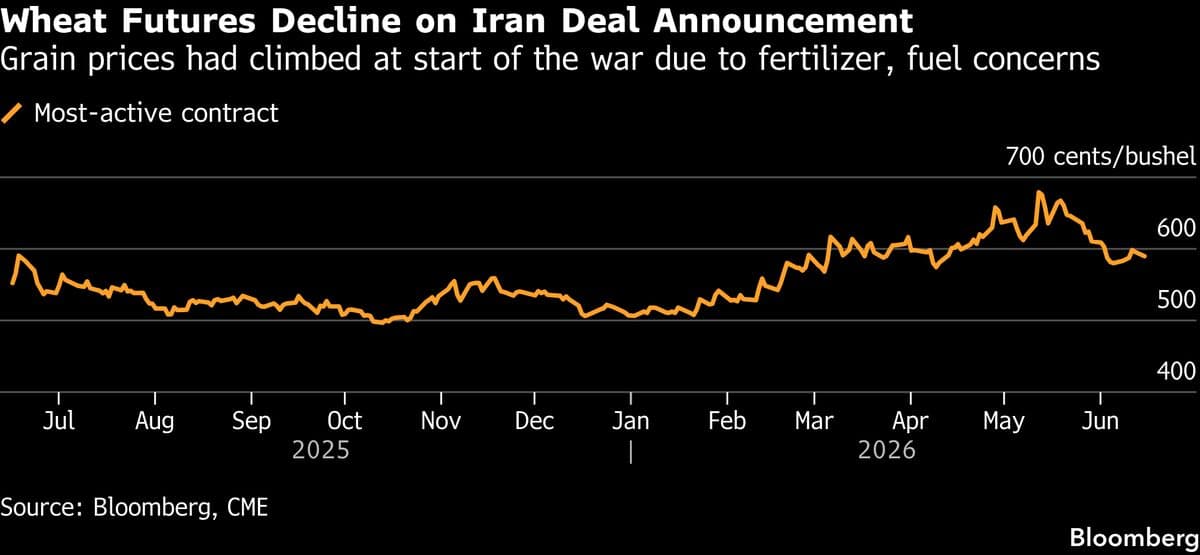
Grain Futures Slide as Strait of Hormuz Reopening Signals Relief for Global Agriculture
Chicago grain futures declined this week following reports that the Strait of Hormuz — one of the world's most strategically critical maritime chokepoints — could be on the verge of reopening after months of wartime disruption. The development sent ripples through global commodity markets, offering a potential reprieve for farmers, agribusinesses, and consumers who have been grappling with soaring food production costs since hostilities in the region first disrupted trade flows.
For agricultural markets, the significance of the Hormuz Strait extends far beyond oil tankers. The waterway is a critical artery for the movement of fertilizers, petrochemical feedstocks, and other crop inputs that underpin modern farming on every continent. Any sustained closure threatens to squeeze the global food supply at its roots — and that is precisely what has been unfolding over recent months.
Why the Strait of Hormuz Matters So Much to Farmers
Most consumers associate the Strait of Hormuz with oil exports from the Persian Gulf. What is less widely understood is just how deeply the passage is woven into the fabric of global agriculture. The region surrounding the strait is home to some of the world's largest producers of ammonia, urea, and other nitrogen-based fertilizers — products that are derived largely from natural gas and are essential for maximizing crop yields worldwide.
When shipping lanes through Hormuz are disrupted, the consequences cascade quickly through the agricultural supply chain. Fertilizer shipments are delayed or rerouted at significant cost. Petrochemical inputs used to manufacture pesticides and herbicides become harder to source. Fuel costs for farm machinery spike as global oil prices respond to supply uncertainty. Taken together, these pressures translate directly into higher production costs for growers and, ultimately, higher prices on supermarket shelves.
Over the course of the current conflict, global fertilizer prices had already begun climbing in anticipation of sustained supply disruption. That concern was baked into grain futures pricing, contributing to elevated benchmark prices for corn, wheat, and soybeans in Chicago — the world's most-watched agricultural commodities exchange.
What a Reopening Would Mean for Farm Input Costs
The prospect of the strait reopening has given commodity traders and agricultural analysts reason for cautious optimism. A resumption of normal shipping traffic through Hormuz would allow fertilizer producers in countries such as Qatar, Saudi Arabia, and the United Arab Emirates to resume full export volumes to markets in Asia, Europe, South America, and North America.
This would likely put downward pressure on urea and diammonium phosphate (DAP) prices relatively quickly, since much of the recent price premium reflected risk rather than an actual physical shortage. As that risk premium unwinds, input costs for the 2025–2026 growing seasons could moderate meaningfully, giving farmers a window to lock in more favorable pricing for the crop nutrients they need.
Reduced farm input costs carry significant implications for food inflation more broadly. When growers face lower production expenses, the pressure to pass costs along to food processors, retailers, and consumers diminishes. Agricultural economists have long noted that fertilizer price spikes are among the most reliable leading indicators of food price inflation, making the potential normalization of Hormuz shipping a meaningful data point for central banks and policymakers monitoring inflation trajectories.
Grain Futures React: A Closer Look at the Chicago Decline
The decline in Chicago grain futures reflects markets repricing the risk environment rather than any immediate physical change in crop supply. Corn, wheat, and soybean contracts all moved lower as traders assessed the likelihood of improved input availability in coming months. In commodity markets, expectations about future supply and cost conditions are constantly being weighed against current fundamentals, and the Hormuz news shifted that calculus in a more bearish direction for grain prices.
It is worth noting that grain prices remain elevated in a historical context. The decline represents a cooling of the war-related risk premium, not a return to pre-conflict price levels. Fundamentals such as weather patterns, planted acreage, and demand from major importing nations will continue to exert their own influence on where corn, wheat, and soybean futures ultimately settle.
Food Inflation: Still a Risk, But the Horizon Is Brightening
Despite the positive signal from potential Hormuz reopening, analysts caution against declaring an end to food inflation pressures. Global grain stocks remain relatively tight following a period of below-average harvests in key producing regions. Demand from population growth, biofuel mandates, and livestock feed requirements continues to grow. And geopolitical risk, by its nature, can reverse quickly — a ceasefire today does not guarantee uninterrupted shipping tomorrow.
Nevertheless, the direction of travel is encouraging. Lower farm input costs, if sustained, will feed through to production decisions in the months ahead, incentivizing farmers in major exporting nations to maximize planted acreage and invest in yield-enhancing inputs. That response is ultimately what brings food prices back toward equilibrium.
What Farmers, Traders, and Consumers Should Watch Next
Fertilizer price indices: Spot prices for urea, DAP, and potash will be among the first market signals to confirm whether Hormuz shipping normalization is translating into genuine input cost relief at the farm level.
Chicago Board of Trade (CBOT) grain contracts: Ongoing movement in corn, wheat, and soybean futures will reflect how traders are continuously reassessing the geopolitical and supply outlook as events develop.
Shipping freight rates: Baltic dry and tanker rates through the Persian Gulf will serve as a real-time proxy for whether maritime traffic is genuinely recovering or remains constrained by residual risk.
Crop input purchasing windows: Farmers who have been deferring fertilizer purchases amid price uncertainty may find emerging opportunities to lock in better pricing as the risk premium unwinds.
The Bigger Picture: Agriculture's Vulnerability to Geopolitical Shocks
The Hormuz episode is a pointed reminder of how exposed modern agriculture is to geopolitical disruption thousands of miles from any farm. The global food system is highly efficient under normal conditions, moving inputs and commodities across oceans with remarkable speed and reliability. But that efficiency comes with a corresponding fragility — a single contested chokepoint can ripple through crop pricing from the Persian Gulf to the American Midwest within days.
As the situation in the region continues to evolve, agricultural stakeholders at every point in the supply chain — from grain farmers in Iowa and Ukraine to bread manufacturers in Egypt and food relief organizations across sub-Saharan Africa — will be watching closely. A durable reopening of the Strait of Hormuz would represent a meaningful step toward stabilizing one of the most consequential pressures on the global food system in recent memory.