
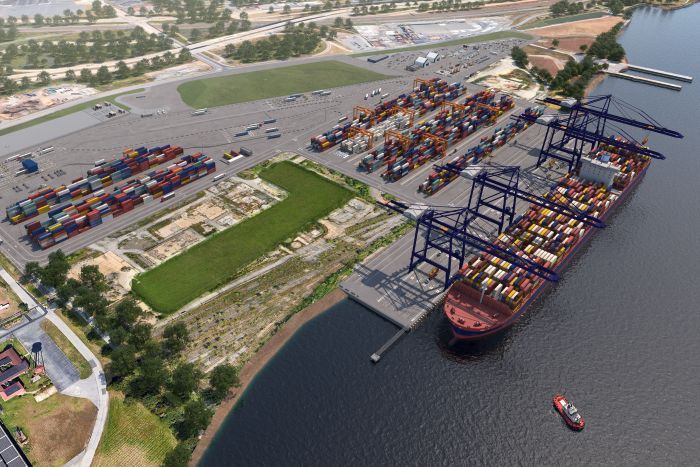
Enstructure Begins Work on Long-Awaited Delaware River Container Terminal
After years of planning and delays, North American terminal operator and stevedore Enstructure has officially taken its first steps toward constructing a major new container terminal along the Delaware River. The project, designed to accommodate big-ship calls and serve the broader mid-Atlantic shipping corridor, represents one of the most significant port infrastructure developments in the region in recent memory. Industry observers, shippers, and logistics professionals are watching closely as the long-delayed terminal moves from concept into early-stage construction reality.
Who Is Enstructure and Why Does This Project Matter?
Enstructure is a well-established name in North American port operations, with a track record spanning terminal management, stevedoring services, and cargo handling across multiple facilities on the East Coast and Gulf Coast. The company has built its reputation by delivering efficient, reliable cargo operations for shippers who depend on consistent port performance to keep their supply chains moving.
The Delaware River terminal project matters for several interconnected reasons. First, it addresses a longstanding infrastructure gap in the mid-Atlantic region, where import and export volumes have steadily grown but available big-ship berth capacity has not kept pace. Second, it positions Enstructure as a forward-looking operator willing to invest heavily in next-generation port infrastructure at a time when many industry players are cautious about capital expenditures. Third, and perhaps most importantly for shippers, it introduces a new competitive option in a region currently served by a limited number of major container gateways.
The Mid-Atlantic Shipping Gap: Why a New Terminal Is Needed
The mid-Atlantic region encompasses some of the most economically productive and densely populated areas of the United States. States such as Pennsylvania, Delaware, New Jersey, Maryland, and Virginia collectively represent a massive consumer and industrial market with significant import demand and substantial export flows in sectors ranging from agriculture to manufacturing.
Despite this economic weight, the region's container port infrastructure has faced persistent constraints. The ports of New York and New Jersey to the north and the Port of Baltimore to the south absorb much of the region's cargo volume, but congestion, capacity limitations, and geographic routing inefficiencies have long pushed shippers to look for alternatives. A purpose-built, big-ship-capable terminal on the Delaware River would allow cargo destined for Pennsylvania and surrounding states to arrive closer to its final destination, reducing inland transportation costs and transit times.
The ability to receive larger vessels is particularly critical in today's shipping environment. The post-Panamax container ships that now dominate global trade routes require deep-draft berths, high-capacity cranes, and extensive yard space. Terminals that cannot accommodate these vessels are increasingly bypassed by major ocean carriers optimizing their port call rotations for efficiency.
What the Early-Stage Work Involves
While detailed engineering and construction timelines are still being finalized, the commencement of initial work signals that Enstructure has cleared the critical early hurdles that have historically slowed this project. These typically include environmental permitting, regulatory approvals from state and federal authorities, land acquisition or long-term lease agreements, and preliminary site preparation. Moving past these milestones is no small achievement for a project of this scale, particularly given the complex regulatory environment governing construction along navigable waterways in the United States.
Early-phase activities at large terminal projects commonly involve geotechnical surveys, site grading, utility infrastructure assessments, and the mobilization of construction equipment and personnel. Each of these steps lays the groundwork for the more capital-intensive civil construction phases that follow, including wharf construction, crane foundation work, and the development of the container yard and gate systems that define a modern terminal's operational capacity.
Implications for Supply Chain Routing in the Mid-Atlantic
For shippers based in the Delaware Valley and surrounding mid-Atlantic states, a functioning Enstructure terminal on the Delaware River could meaningfully change how they approach import and export logistics. Among the potential benefits worth monitoring are the following considerations.
- Shorter drayage distances: Cargo arriving at a Delaware River terminal rather than at the Port of New York and New Jersey or the Port of Baltimore could reduce truck drayage miles for many Pennsylvania-based importers and exporters, lowering cost and carbon footprint simultaneously.
- Increased carrier competition: A new terminal capable of handling large vessels would attract ocean carrier interest, potentially increasing the number of direct service calls available to regional shippers and reducing reliance on transshipment or feeder services.
- Supply chain resilience: Having an additional gateway option strengthens regional supply chain resilience, giving shippers an alternative when congestion or disruptions affect neighboring ports.
- Economic development: Terminal construction and operation generate significant local employment, from construction trades during the build phase to longshore labor, truck drivers, and logistics professionals once the facility is operational.
Challenges Ahead for Enstructure and the Delaware Terminal
Despite the encouraging news of construction beginning, Enstructure and the Delaware terminal project still face a demanding road ahead. Large-scale port infrastructure projects routinely encounter cost escalations, extended construction timelines, and the ongoing challenge of securing long-term vessel service commitments from ocean carriers before a terminal is fully operational. Attracting anchor carrier partnerships early in the development cycle is widely considered essential to financial viability.
Competitive dynamics will also play a role. Neighboring ports have not stood still while this project has been in development, and both the Port of Baltimore and the Port of New York and New Jersey have made their own infrastructure investments in recent years. Enstructure will need to present a compelling value proposition in terms of efficiency, pricing, and service reliability to win cargo from established gateways.
A Significant Moment for East Coast Port Development
The first steps taken by Enstructure on its Delaware River container terminal represent more than a single company's construction milestone. They signal renewed momentum in East Coast port development at a time when American supply chain policymakers, shippers, and logistics professionals are actively seeking ways to reduce congestion, distribute cargo flows more efficiently, and build infrastructure resilient enough to handle the demands of modern global trade. As the project advances, it will be one of the most closely watched port development stories in North America.