
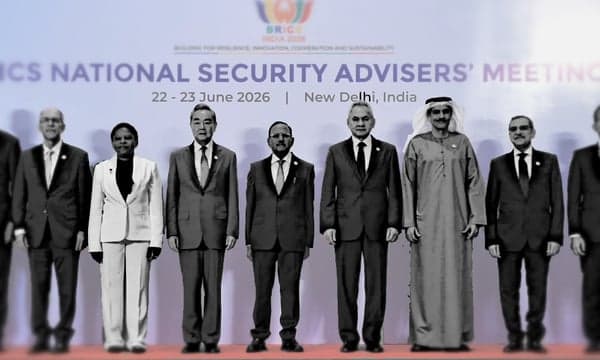
The Future of BRICS After the Iran War
The geopolitical landscape that surrounds the BRICS bloc has rarely been more volatile or more consequential. With the dust still settling from the Iran War, a conflict whose reverberations have been felt from energy markets to diplomatic corridors across the Global South, the question of what comes next for BRICS has never been more pressing. As India holds the rotating presidency of the bloc and steers member nations toward the September 2025 leaders' summit, analysts and policymakers are watching closely to see whether BRICS can maintain cohesion amid mounting tensions and diverging national interests.
In a detailed discussion, international relations scholar Carlos Frederico Pereira da Silva Gama and host Tushar Shetty explored the complex terrain that India must navigate as it chairs the world's most consequential emerging-economy coalition. Their conversation surfaced critical fault lines within the bloc while also highlighting the genuine opportunities that India's leadership could unlock.
India's BRICS Presidency: Priorities and Ambitions
India assumed the BRICS presidency at a uniquely challenging moment. The country has long positioned itself as a bridge between the West and the Global South — a balancing act that becomes dramatically more difficult in a post-Iran War environment, where great-power competition has intensified and neutrality is increasingly hard to sustain.
Under New Delhi's leadership, several priorities have emerged as central to the agenda heading into September's summit.
- Reforming the global financial architecture: India has championed calls to reduce dependence on the US dollar in intra-BRICS trade, advocating for mechanisms that allow member states to settle transactions in local currencies. This agenda has gained urgency following the economic disruptions triggered by the Iran War and the subsequent rounds of Western sanctions.
- Expanding BRICS membership strategically: Following the bloc's historic enlargement in 2024, India is keen to ensure that new members are integrated in a way that enhances rather than dilutes the group's collective voice. Managing the ambitions and expectations of newer entrants while keeping the original core aligned is a delicate diplomatic task.
- Positioning BRICS as a development-focused forum: New Delhi has consistently argued that BRICS should foreground economic development, technology transfer, and food security rather than becoming a purely anti-Western geopolitical platform. This framing appeals to the African and South American members of the expanded bloc.
How the Iran War Reshaped BRICS Dynamics
No analysis of the current BRICS moment is complete without accounting for the Iran War and its cascading effects. The conflict exposed and deepened pre-existing fractures within the bloc. China and Russia, both BRICS founding members, have maintained positions broadly sympathetic to Iran, while India has treaded far more carefully, mindful of its strategic partnerships with Gulf states and its historically close ties with the United States.
The war also triggered an energy price shock that affected BRICS members in vastly different ways. Russia, as a major energy exporter, saw revenue windfalls even as its international isolation deepened. India and China, both massive energy importers, scrambled to diversify supply chains. Smaller and newer BRICS members felt the squeeze acutely, reinforcing calls within the bloc for a collective energy security strategy.
Perhaps most significantly, the Iran War forced a reckoning over what BRICS actually stands for. Is it a coalition of convenience among large economies skeptical of Western hegemony? Is it a platform for genuine multilateral cooperation on shared development challenges? Or is it, as critics suggest, an increasingly unwieldy grouping whose internal contradictions prevent coherent action? India's presidency has the unenviable task of managing all three of those competing narratives simultaneously.
Divergences Within the Bloc: The Elephant in the Room
As Gama and Shetty noted, the divergences within BRICS are not merely matters of diplomatic nuance — they reflect fundamentally different visions for the bloc's role in the emerging multipolar world. China envisions a BRICS that more explicitly challenges US-led institutions, while India prefers a reform-oriented stance that works within and alongside existing multilateral frameworks. Russia, increasingly isolated, looks to BRICS for the legitimacy and economic connectivity that Western sanctions have stripped away.
These fault lines become even more pronounced when the conversation turns to the post-Iran War order. Questions about recognizing or engaging with particular governments, energy deal structures, and infrastructure financing through the New Development Bank all carry heightened political weight in the current environment. Building consensus on even procedural matters requires extraordinary diplomatic effort.
Brazil and South Africa, both democracies with strong civil society sectors, bring their own sensitivities — particularly around human rights language and governance standards for development financing. The expanded membership from the Gulf and Africa adds further complexity, with each new member carrying its own bilateral relationships and red lines.
What to Expect from the September 2025 Leaders' Summit
Despite the headwinds, analysts believe the September summit will produce meaningful outcomes in several areas. Currency and payment system cooperation, New Development Bank capitalization, and a joint statement on global governance reform are all likely agenda items. Whether the summit can also deliver a unified position on the post-Iran War regional order is a far greater ask.
India is expected to leverage the summit to showcase its credentials as a responsible, consensus-building global power — reinforcing its case for a permanent seat on a reformed UN Security Council and signaling to both Western and non-Western partners that it remains a reliable interlocutor.
Conclusion: BRICS at a Crossroads
The future of BRICS after the Iran War will ultimately be shaped by whether its members can subordinate short-term national interests to a longer-term collective vision. India's presidency offers a genuine opportunity to chart that course, but the path is strewn with genuine divergences and geopolitical pressures that no amount of diplomatic skill can entirely smooth over. The September 2025 leaders' summit will be a critical test — not just for India's presidency, but for the very idea of BRICS as a cohesive force in a rapidly shifting world order.