
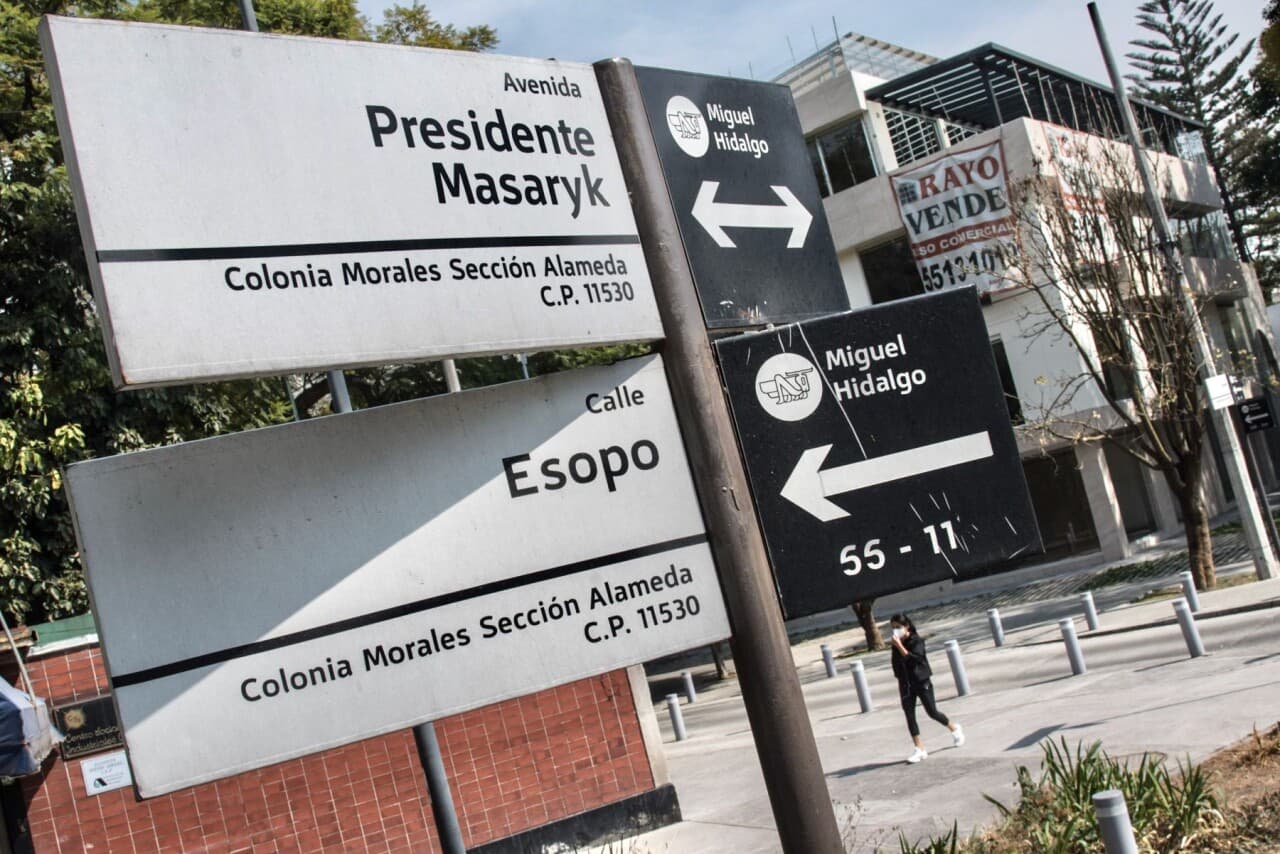
The Story Behind One of Latin America's Most Famous Avenues
Walk down Avenida Presidente Masaryk on any given afternoon and you'll be surrounded by the gleaming windows of Chanel, Louis Vuitton, Porsche showrooms, and Michelin-starred restaurants. To most visitors, this elegant boulevard in the heart of Polanco, Mexico City, reads as a monument to modern luxury. But behind the designer storefronts and valet parking lines lies a story that stretches back nearly 90 years — one rooted not in fashion or gastronomy, but in democracy, exile, and the unlikely friendship between two nations separated by nearly 10,000 kilometers.
Avenida Presidente Masaryk is not just Mexico City's most expensive street. It is a living tribute to a man who dedicated his life to defending democratic values in one of Europe's most turbulent eras, and whose legacy found an unlikely home in the hills of western Mexico City.
Who Was Tomáš Garrigue Masaryk?
To understand why a street in Mexico bears his name, you first need to understand the man himself. Tomáš Garrigue Masaryk was born in 1850 in Hodonín, a town that was then part of the Austro-Hungarian Empire, in what is today the Czech Republic. A philosopher, sociologist, academic, and statesman, Masaryk was far more than a conventional politician. He was an intellectual who believed deeply that democracy was not just a system of government but a moral imperative.
After decades of political activism and academic work, Masaryk became the founding president of Czechoslovakia when the country was established in 1918 following the collapse of the Austro-Hungarian Empire at the end of World War I. According to the Embassy of the Czech Republic in Mexico, he is widely regarded as the father of the modern Czechoslovak state. He governed until 1935, making him one of the longest-serving and most respected democratic leaders in interwar Europe — a period defined by the fragile aftermath of World War I, the punishing terms of the Treaty of Versailles, and the slow, ominous rise of fascism and totalitarianism across the continent.
Masaryk stood in firm opposition to those forces. He championed parliamentary democracy, civil liberties, minority rights, and international cooperation at a time when many European leaders were moving in the opposite direction. His presidency oversaw a period of remarkable stability and cultural flourishing in Czechoslovakia, even as neighboring states descended into authoritarianism. He died in 1937, just a year before the Munich Agreement dismantled the country he had built.
Why Did Mexico Honor a Czech President?
The decision to name one of Mexico City's key avenues after Masaryk was made during the presidency of Lázaro Cárdenas, one of Mexico's most progressive and internationally minded leaders. Cárdenas governed from 1934 to 1940, a period that overlapped with the final years of Masaryk's life and the early catastrophe of World War II. His administration was defined by land reform, the nationalization of the oil industry, and a strong commitment to offering refuge to those fleeing fascist regimes in Europe.
Under Cárdenas, Mexico became a haven for thousands of Spanish Republicans fleeing Franco's dictatorship, as well as Jewish refugees and intellectuals escaping Nazi persecution. It was in this spirit of democratic solidarity that the Mexican government chose to honor Masaryk. Naming an avenue after him was a deliberate and symbolic act — a statement that Mexico stood with the values of democracy and human dignity that Masaryk had represented, at a moment when those values were under existential threat in Europe.
Polanco: From Residential Neighborhood to Luxury Epicenter
When the avenue was first named, Polanco was a relatively quiet, upper-middle-class residential neighborhood. Developed in the 1930s and 1940s, it was designed with wide, tree-lined streets and an urban grid influenced by European city planning. Many of the early residents were Jewish immigrants and families fleeing Europe, giving the neighborhood a cosmopolitan character from its earliest days.
Over the following decades, Polanco evolved steadily. Embassies relocated there. High-end restaurants began to appear. By the 1990s and 2000s, global luxury brands had identified Masaryk as the ideal address in Latin America. Today, the avenue is frequently compared to the Champs-Élysées in Paris or Fifth Avenue in New York, and is considered the most expensive commercial real estate corridor in Mexico and one of the priciest in the entire region.
What You'll Find on Masaryk Today
- Flagship stores for international luxury brands including Hermès, Dior, Gucci, and Tiffany & Co.
- High-end automobile dealerships and exclusive concierge services.
- Award-winning restaurants led by internationally recognized chefs.
- Five-star hotels and boutique accommodations catering to global travelers.
- Art galleries, upscale spas, and premium fitness studios.
A Bridge Between Mexico and Czechia
The connection between Mexico and the Czech Republic runs deeper than a street name. Both countries share a history of resisting imperial domination — Mexico through its independence from Spain and its resistance to French intervention in the 19th century, and Czechoslovakia through its struggle for sovereignty from the Austro-Hungarian Empire. Both nations also experienced the brutal costs of having their democratic institutions threatened or dismantled by outside forces.
Today, that symbolic bond is occasionally brought to life through cultural events, diplomatic exchanges, and sporting encounters. When the Czech national football team visits Mexico to compete at the Estadio Ciudad de México, that shared history becomes more than a footnote — it becomes a living reminder of how deeply two nations can be linked through shared values rather than geographic proximity.
A Legacy Worth Remembering
It is easy to walk down Avenida Presidente Masaryk and see only the luxury. But the name above the boutiques carries real weight. Tomáš Garrigue Masaryk was a man who built a democratic nation from scratch, defended it against the tide of authoritarianism, and inspired leaders across the world with his conviction that freedom and justice were worth fighting for. That Mexico chose to honor him — not a military hero or a monarch, but a philosopher-president who believed in the power of ideas — says something important about the values that shaped this city.
Next time you stroll past the designer windows and open-air terraces of Polanco's most famous boulevard, take a moment to consider the history embedded in its name. Behind the gloss of one of Latin America's most glamorous streets lies a story of democracy, solidarity, and the enduring connection between two nations that found common ground in their shared respect for human dignity.