
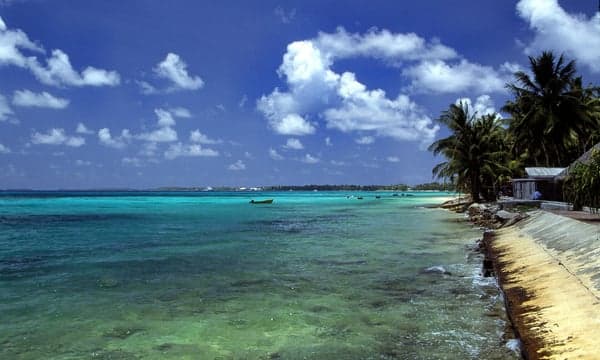
A Nation Racing Against the Tide
Somewhere in the middle of the Pacific Ocean, a nation is disappearing — not because of war, economic collapse, or political failure, but because the ocean is slowly swallowing it whole. Tuvalu, a tiny archipelago of nine coral atolls with a population of just over 11,000 people, sits an average of two meters above sea level. That number, already alarming, is shrinking. Storm surges flood homes with increasing frequency. Saltwater creeps into freshwater supplies. Entire stretches of coastline are eroding year by year. By the end of this century, much of Tuvalu's land may be physically uninhabitable.
But here is what makes Tuvalu extraordinary: rather than quietly accept its fate, it is doing something no country has ever attempted before. It is rethinking what a nation fundamentally is — and in doing so, it may be rewriting international law for generations to come.
The Traditional Definition of a State — and Why It No Longer Works
For more than a century, the legal definition of a state has been largely governed by the 1933 Montevideo Convention, which established four criteria: a permanent population, a defined territory, an effective government, and the capacity to enter into relations with other states. This framework has served the international community reasonably well — but it was written in a world where no one imagined an entire country's territory might vanish beneath rising seas.
Climate change has exposed a catastrophic blind spot in that framework. If Tuvalu loses its land, does it cease to exist as a state? Do its citizens lose their nationality? Do its Exclusive Economic Zone rights — covering 900,000 square kilometers of ocean rich in fish stocks and deep-sea minerals — simply dissolve? Under traditional interpretations, the answer to all three questions could be yes. For Tuvalu, that outcome is unthinkable. And so its government has decided to act before the water arrives.
The World's First Digital Nation
In November 2023, Tuvalu and Australia signed the Falepili Union, a landmark bilateral treaty that made headlines around the world. Among its most striking provisions was a guarantee of residency rights for Tuvaluans in Australia — a form of climate mobility agreement that acknowledged, with rare political honesty, that people may need to relocate before their nation disappears. But the treaty's most philosophically radical element was its recognition of Tuvalu's intention to maintain statehood in perpetuity, even if its physical territory becomes uninhabitable.
To make that promise meaningful, Tuvalu has been building what it calls a "digital nation." The concept involves digitizing the entirety of the country's cultural heritage, governmental records, land titles, and legal frameworks — preserving the institutional memory and identity of a state in a form that does not depend on physical land. Tuvalu's government would continue to function, potentially from Australian territory or through virtual governance structures, with full legal continuity maintained under international law.
It is, in essence, the world's first attempt to decouple sovereignty from geography.
What Sovereignty Without Territory Actually Means
The implications of this experiment stretch far beyond the Pacific. Tuvalu's approach raises profound questions that legal scholars, geopolitical strategists, and climate scientists are only beginning to grapple with.
If a state can exist without land, it challenges one of the foundational assumptions of the Westphalian international order — the idea that political authority is inherently territorial. It could open the door for other low-lying nations, such as Kiribati, the Marshall Islands, and the Maldives, to pursue similar arrangements. It could reshape how the United Nations recognizes and interacts with member states. And it could dramatically change the calculus around maritime rights, since a stateless people would likely lose access to their Exclusive Economic Zone, while a continuing state — even a landless one — would retain it.
Tuvalu's leadership has been explicit about protecting those ocean rights. The country's EEZ is not merely a sentimental asset; it is an economic lifeline worth potentially hundreds of billions of dollars in fish, minerals, and future deep-sea resources. Allowing that territory to revert to international waters upon the loss of land would be, in the words of Tuvaluan officials, a second dispossession layered on top of the first.
A Moral Argument the World Cannot Ignore
There is a powerful moral dimension to Tuvalu's fight that sits at the heart of global climate negotiations. The country contributes an almost immeasurably small fraction of global greenhouse gas emissions — far less than one tenth of one percent. Yet it faces existential consequences from the industrial activity of others. This injustice has made Tuvalu one of the most compelling and impassioned voices at international climate summits, and its leaders have not been shy about using that platform.
Former Prime Minister Simon Kofe famously delivered a United Nations address standing knee-deep in seawater, wearing a suit and tie, to visually dramatize what was coming. His government has consistently argued that allowing small island states to disappear without legal remedy would set a devastating precedent — effectively signaling that the international community is willing to let entire peoples and cultures be erased by a crisis they did not create.
The Precedent Being Set Right Now
Whether Tuvalu's gamble succeeds will depend on far more than its own determination. It will require other nations to recognize and uphold the concept of a continuing state without territory — a legal novelty with no firm precedent. It will require international institutions to adapt frameworks that have not fundamentally changed in nearly a century. And it will require the world to take seriously the idea that sovereignty is not just about land, but about people, culture, governance, and identity.
What Tuvalu is doing is not merely an act of political survival. It is a philosophical argument, delivered in real time, about what nations are truly made of. And as the seas continue to rise, more countries may soon be forced to listen.