
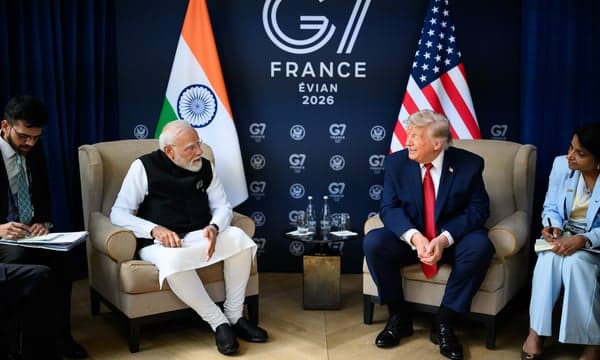
India's Strategic Tilt Toward the US: A Partnership Built on Uneven Ground
For decades, India prided itself on its tradition of strategic autonomy — a foreign policy doctrine inherited from the Nehruvian era that kept New Delhi carefully equidistant from competing global power centers. That carefully cultivated neutrality, once the cornerstone of Indian diplomacy, has been quietly eroding. What began as a gradual balancing act between Washington and other major powers has, in recent years, hardened into a visible tilt toward the United States. Yet despite this realignment, India finds itself receiving very little in return. No carrots — only sticks.
From Balance to Tilt: How India's Foreign Policy Shifted
The shift did not happen overnight. It was the product of compounding pressures: a rising and increasingly assertive China on India's northern border, the gradual obsolescence of the Non-Aligned Movement as a meaningful force in global affairs, and a growing convergence of economic and security interests between New Delhi and Washington. The 2008 civilian nuclear deal was a landmark moment, signaling that India was willing to accept a closer embrace from the United States in exchange for recognition as a legitimate nuclear power.
Since then, the relationship has deepened considerably. India joined the Quad — the strategic grouping of the US, Australia, Japan, and India — framing it as a platform for a free and open Indo-Pacific. Defense cooperation has expanded, with India purchasing billions of dollars in American military hardware. Intelligence-sharing arrangements have grown more sophisticated. At every global forum, India and the US increasingly find themselves on the same side of the room, if not always the same side of the argument.
But a shift in posture is not the same as a shift in leverage. India has moved toward Washington without necessarily improving its bargaining position within the relationship.
Washington's Expectations Keep Growing
The core problem with India's tilt is that it has not been rewarded with a corresponding sense of reciprocity from Washington. Instead, American expectations of India appear to have grown in direct proportion to India's accommodation. The closer India leans, the more Washington seems to expect — and the less forgiving it becomes when India diverges.
This dynamic was thrown into sharp relief after Russia's invasion of Ukraine in February 2022. India refused to condemn Russia at the United Nations, continued purchasing Russian oil at discounted prices, and maintained its long-standing defense relationship with Moscow. Washington was displeased. American officials made little effort to hide their frustration, publicly pressing India to fall in line with the Western consensus on Russia, despite the fact that India's relationship with Russia predates its relationship with the United States and serves distinct strategic interests — particularly in defense procurement and energy security.
India's position was nuanced and defensible on its own terms. Yet the reaction from Washington treated it less as the considered policy of a sovereign partner and more as a loyalty test that India had partially failed. The message was clear: alignment is expected, not optional.
The Stick Without the Carrot
What makes this particularly frustrating from an Indian perspective is the asymmetry of the exchange. India has made real concessions in its strategic posture — distancing itself, at least in optics, from some of its historical partners, deepening military interoperability with US forces, and increasingly aligning its public rhetoric with Washington's preferred framing of international issues. These are not costless moves. They carry diplomatic risks, domestic political sensitivities, and real constraints on India's future freedom of maneuver.
In return, India has received comparatively little. American trade policy has not been especially generous to Indian exports. Visa restrictions on Indian workers — a significant irritant in the bilateral relationship — have not been meaningfully relaxed. Technology transfer, which India has sought as a condition for deeper defense cooperation, remains heavily guarded. And whenever India pushes back on American demands, Washington does not hesitate to apply pressure, whether through the threat of sanctions, public criticism, or diplomatic leverage in multilateral institutions.
This is what a lopsided partnership looks like in practice: one side offering loyalty, the other offering leverage.
The Geopolitical Stakes for India
India's challenge is that it cannot easily reverse course. Having tilted, the costs of re-balancing are higher than they were before. A sharp pivot away from Washington now would damage hard-won trust, disrupt defense supply chains, and send a signal of unreliability to other potential partners. India is, to some extent, locked into a trajectory it chose but did not fully negotiate.
At the same time, India's strategic environment is not getting simpler. The China challenge remains acute. The Russia-Ukraine war has scrambled traditional alignments. The Global South is restless, and India's aspiration to lead it sits awkwardly alongside its deepening embrace of Western institutional frameworks.
What India Needs to Demand
If India is to transform its tilt into a genuinely productive partnership, it needs to negotiate from a clearer sense of its own value. New Delhi brings substantial assets to the table: a large and growing economy, a strategically located geography, a capable military, and a democratic legitimacy that Washington finds useful in its competition with Beijing. These assets should translate into tangible concessions — on trade, on technology, on visa access, on being treated as a co-equal partner rather than a junior ally.
Strategic autonomy, properly understood, does not mean equidistance from all powers. It means the ability to act in one's own interest without being dictated to. India has not lost that ability, but it risks doing so if it continues to offer loyalty without demanding leverage in return.
Conclusion: Recalibrating the Relationship
India's tilt toward the United States reflects real strategic logic, but it has been executed in a way that has left India with fewer options and less respect than it deserves. Washington has grown accustomed to India's accommodation and has responded not with generosity but with escalating expectations. For the partnership to be sustainable — and genuinely beneficial — India must move beyond the role of eager partner and establish itself as an indispensable one. Loyalty without leverage is not a strategy. It is a vulnerability.