
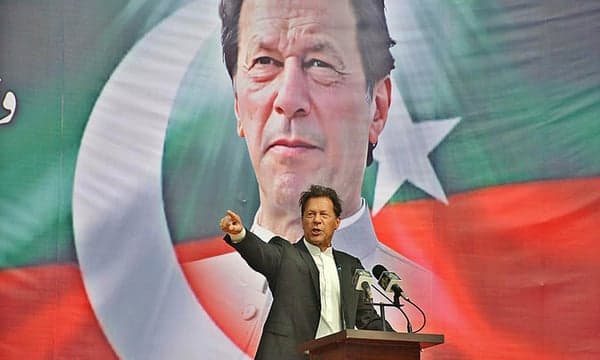
Pakistan at a Crossroads: Military Power and the Fate of Imran Khan
Pakistan has never been a stranger to the long shadow of its military establishment. But the pace at which Field Marshal Asim Munir has consolidated power in recent months has stunned even veteran observers of the country's turbulent political landscape. As the armed forces tighten their grip on the levers of state, Imran Khan's Pakistan Tehreek-e-Insaf (PTI) finds itself at an existential crossroads — forced to reassess its strategy, its alliances, and its very survival as a political force.
The question being asked in Islamabad's drawing rooms and on social media feeds across the country is no longer simply whether Imran Khan will return to power. It is whether the political movement he built from the ground up can survive in any meaningful form at all.
The Rise of Field Marshal Asim Munir
Asim Munir's ascent to the rank of Field Marshal — a title that carries enormous symbolic and institutional weight in Pakistan — signals something far more significant than a ceremonial promotion. It represents the formal consolidation of military authority at a moment when civilian political institutions remain fragmented and weakened. The elevation is widely seen as a deliberate assertion of dominance, one designed to send an unambiguous message to political actors both inside and outside the country.
Munir has long been viewed as a figure with deep-seated animosity toward Imran Khan. The two men clashed when Khan was prime minister, and their rivalry has only intensified since Khan's removal from power in 2022. Under Munir's watch, the military apparatus has moved methodically against PTI — arresting party leaders, pressuring members to defect, and using the judiciary and bureaucracy as instruments of political containment.
The result has been a systematic dismantling of PTI's organizational infrastructure. Hundreds of party workers remain behind bars. Senior figures have publicly distanced themselves from Khan or announced their retirement from politics altogether. The party that once mobilized millions in the streets of Lahore and Karachi now struggles to hold together a coherent leadership structure.
PTI's Shrinking Options
For the PTI, the strategic picture has rarely looked bleaker. The party's core dilemma is a familiar one in Pakistani politics: how do you resist an institution that controls the military, has deep influence over the judiciary, and can make life extraordinarily difficult for anyone who stands in its way — all while maintaining the moral high ground that has been central to Khan's political brand?
In the wake of Munir's consolidation, PTI insiders have reportedly begun serious internal debates about whether a more conciliatory posture is necessary for the party's survival. Some voices within the movement argue that continued confrontation is not only futile but dangerous — that the military's current mood leaves no room for the kind of mass mobilization that PTI deployed so effectively in 2022 and 2023.
Others, particularly among Khan's most loyal supporters, reject any talk of compromise as capitulation. They argue that Khan's political identity is inseparable from his defiance of the establishment, and that backing down would hollow out the very thing that made PTI different from every other party in Pakistan.
- Khan remains incarcerated, with legal proceedings dragging through courts widely perceived as subject to institutional pressure.
- PTI's social media infrastructure — once its most potent organizing tool — has faced repeated disruptions and regulatory crackdowns.
- Several senior party figures have either been arrested, gone into exile, or publicly resigned from PTI.
- International attention on Khan's imprisonment has produced diplomatic murmurs but little concrete pressure on Islamabad.
The Charter of Democracy: A Controversial Lifeline?
One of the most intriguing developments in this unfolding crisis is the renewed — and deeply contentious — discussion around a so-called "charter of democracy." The concept, in its most basic form, envisions a grand political bargain among Pakistan's major civilian parties to present a united front against military overreach and work toward restoring genuine civilian supremacy over state institutions.
The idea is not new. A version of it was famously signed by Benazir Bhutto and Nawaz Sharif in London in 2006 when both were in exile and the Musharraf government appeared unassailable. That agreement helped pave the way for the lawyers' movement and the eventual restoration of democracy — though its promises were only partially kept once the two parties returned to power.
For PTI, the prospect of signing onto such a charter is complicated by history and pride. Khan built his political career on relentless attacks against both the PPP and PML-N, accusing them of corruption, dynastic politics, and — crucially — of being complicit with the very military establishment that now threatens his own party. Joining hands with Asif Ali Zardari's PPP or Nawaz Sharif's PML-N would require a level of ideological contortion that many PTI supporters would find impossible to accept.
And yet, the logic of necessity has a way of overriding ideological purity in Pakistani politics. The question is whether PTI's leadership — operating largely without Khan, who remains imprisoned — has the authority or the will to make such a consequential shift.
What Comes Next for Pakistani Democracy?
The broader stakes extend well beyond the fate of one party or one man. Pakistan's democratic trajectory has always been fragile, punctuated by coups, forced resignations, and judicial interventions that served military rather than civilian interests. The current moment feels, to many analysts, like one of the more decisive turning points in that long and troubled history.
If the military's consolidation under Asim Munir goes effectively unchallenged — by PTI, by other civilian parties, or by civil society — it sets a precedent for the degree of political control the establishment can exercise going forward. Conversely, if PTI finds a way to survive and regroup, either through a charter of democracy or through some other political realignment, it could test the limits of what the military can sustain politically, particularly given the severe economic pressures Pakistan continues to face.
What is clear is that Pakistan's political drama is far from over. Imran Khan may be behind bars, and his party may be under siege, but the forces that brought PTI to prominence — widespread disillusionment with traditional elites, a young and digitally connected population, and a deep hunger for accountability — have not disappeared. Whether those forces can be harnessed without Khan at the helm, and against an ascendant military that has rarely looked more firmly in control, is the defining question of Pakistan's political moment.
The answer will shape not just the future of one polarizing leader, but the kind of country Pakistan chooses — or is allowed — to become.