
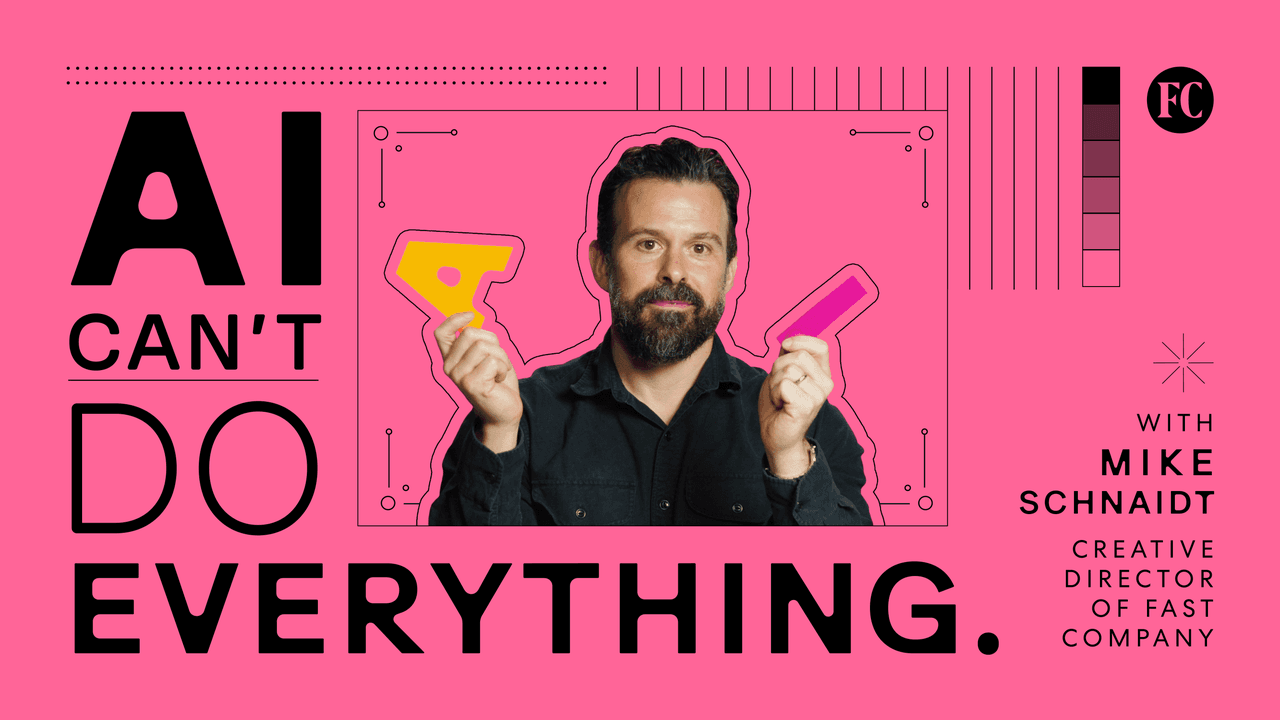
AI Can Do a Lot — But It Can't Do This
Artificial intelligence has rewritten the rules of nearly every industry it touches. It writes code, composes music, generates images, drafts legal documents, and even holds conversations that are increasingly difficult to distinguish from those with a real human being. The pace of AI's advancement has been nothing short of breathtaking, and for many creative professionals, it has raised a deeply uncomfortable question: is there anything left that humans do better?
As it turns out, yes. And one of the most compelling answers to that question can be found on the cover of Fast Company's Summer 2026 issue — a carefully crafted, intentionally human piece of design that proves authentic creative vision is still very much a human domain.
Fast Company's Summer 2026 Issue: Autonomy Under the Microscope
The Summer 2026 issue of Fast Company tackles one of the most urgent themes of our time: autonomy. In an era where AI systems are making more decisions — in medicine, finance, transportation, and beyond — the question of who (or what) is truly in control has never been more relevant. To match the gravity of that theme, the magazine compiled a list of the 20 biggest names in artificial intelligence today, spotlighting the people and personalities actively shaping the trajectory of this technology.
But perhaps the most striking statement the issue makes is not written in any article. It's expressed visually, through the deliberate and deeply considered design choices made by Fast Company creative director Mike Schnaidt. Because when it came time to bring this landmark issue to life, the team didn't turn to an AI image generator or an automated layout tool. They turned to human judgment, human taste, and the nuanced art of typography.
Meet the Creative Director: Mike Schnaidt's Design Philosophy
Mike Schnaidt has long been one of the most thoughtful voices in editorial design, and his approach to the Summer 2026 cover is a masterclass in intentionality. For Schnaidt, every design decision is a form of communication. The typeface you choose, the weight you assign to a headline, the tension between two competing visual elements — these are all choices that carry meaning, and meaning is something that cannot be automated away.
In breaking down the design process behind the cover, Schnaidt emphasizes that the selection of typefaces is never arbitrary. It is the result of a careful negotiation between concept, context, audience, and emotion. And for an issue exploring autonomy — a concept that sits at the very heart of what makes us human — that negotiation was especially charged.
The Typefaces: Why Ease and Milling?
Schnaidt chose two typefaces for the Summer 2026 cover: Ease and Milling. On the surface, these might seem like simple stylistic choices. But dig deeper and you'll find a sophisticated visual argument being made about the nature of technology, humanity, and control.
Ease, as a typeface, carries a sense of fluidity and approachability. Its letterforms suggest movement and accessibility — qualities that evoke the promise AI makes to the world: that complex things will become simpler, that friction will be reduced, that technology will smooth the rough edges of everyday life. There is an optimism embedded in its curves.
Milling, by contrast, brings a more structured, almost mechanical precision to the composition. Its forms suggest process, production, and the systematic nature of machine logic. Placed alongside Ease, it creates a visual dialogue — the human and the mechanical, the organic and the engineered, in direct conversation with each other.
Together, the two typefaces do something that no AI-generated design brief could have produced: they tell a story that mirrors the issue's thematic content. That is the kind of layered, resonant decision-making that emerges from years of cultural literacy, aesthetic sensitivity, and lived creative experience.
Why AI Still Can't Replace Human Design Thinking
This is not an argument against AI. Artificial intelligence has become an invaluable tool across the creative industries, helping designers explore concepts faster, iterate more freely, and access resources that were once out of reach. Its role in the creative process is real and growing.
But there is a fundamental difference between a tool that assists creative thinking and a system that replaces it. What Schnaidt demonstrates with the Summer 2026 cover is that the highest level of design work is not about producing something that looks correct — it is about producing something that means something. That requires cultural awareness, emotional intelligence, and the kind of contextual judgment that comes from being a human being embedded in the world the design is speaking to.
AI can generate thousands of typeface combinations in seconds. It cannot feel the particular tension that arises when a word like "autonomy" is set in a typeface that subtly challenges the reader's expectations. It cannot intuit that a magazine exploring the power of AI needs a cover that quietly reasserts the irreplaceable value of human craft. That insight belongs entirely to the designer.
The Bigger Picture: Human Creativity in the Age of AI
The Summer 2026 issue of Fast Company is, in many ways, a meditation on what it means to be human in an age of increasingly capable machines. And the cover itself — designed by a human, for humans, using tools selected with human wisdom — embodies that meditation in physical form.
As AI continues to evolve and its capabilities continue to expand, the creative community will keep wrestling with questions about originality, authorship, and the unique value of human-made work. The answer that Mike Schnaidt and the Fast Company design team offer is both simple and profound: authenticity cannot be automated. The choices that make a design truly great — the ones that connect, resonate, and endure — are still made by people who bring something no algorithm can replicate: a point of view.
So the next time someone tells you AI can do everything, point them to a magazine cover. Point them to two typefaces named Ease and Milling. And remind them that there are still places where only a human hand will do.