
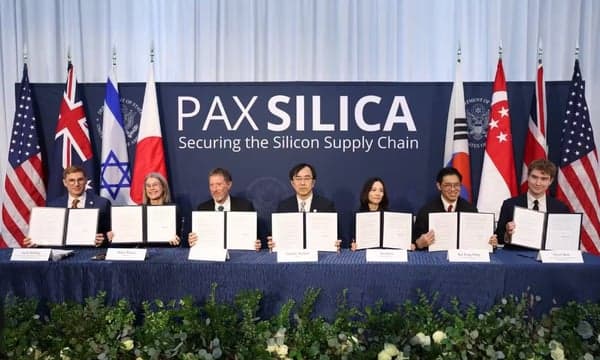
Pax Silica and the New Geopolitics of the Indo-Pacific
In an era defined as much by microchips as by missiles, a new framework is quietly reshaping how nations in the Indo-Pacific think about power, partnership, and prosperity. Analysts and strategists have begun referring to this emerging order as Pax Silica — a term that captures the idea that control over semiconductor technology, silicon supply chains, and advanced chip manufacturing now anchors geopolitical stability in the same way that naval dominance once defined earlier international orders. Akhil Ramesh, a noted expert on Indo-Pacific affairs and technology policy, has been among the foremost voices illuminating what this shift means for the region and for the global balance of technological power.
What Is Pax Silica?
The phrase Pax Silica draws a deliberate analogy to historical concepts like Pax Americana or Pax Britannica — periods in which a dominant power or coalition of powers maintained international order through a combination of military strength, economic leverage, and institutional influence. Today, the argument goes, silicon — the foundational material behind semiconductors — has become the equivalent of the oil fields, sea lanes, and industrial capacity that defined earlier eras of strategic competition.
Semiconductors are embedded in virtually every dimension of modern economic and military life, from consumer electronics and autonomous vehicles to advanced weapons systems, artificial intelligence platforms, and critical infrastructure. Nations that can design, manufacture, and export cutting-edge chips occupy a position of extraordinary leverage. Those that cannot — or those forced to rely on potentially adversarial suppliers — face profound vulnerabilities. Pax Silica, in this framing, describes the emerging order in which semiconductor leadership defines hierarchy among nations.
Akhil Ramesh's Perspective on Indo-Pacific Alignment
Akhil Ramesh, whose work on Indo-Pacific security and technology policy has been widely cited in policy circles, argues that the semiconductor question is no longer merely a commercial or industrial issue — it is a foundational pillar of regional security architecture. His insights point to several key dynamics that are reshaping how Indo-Pacific partners think about cooperation, dependency, and strategic autonomy.
First, Ramesh highlights the growing recognition among Indo-Pacific nations that diversifying semiconductor supply chains is not simply an economic hedge but a national security imperative. The COVID-19 pandemic exposed how fragile global chip supply chains could be, and subsequent export control measures between the United States and China made it abundantly clear that access to advanced semiconductors could be weaponized in geopolitical competition. For countries in the Indo-Pacific, this created both urgency and opportunity.
Second, Ramesh points to the emergence of plurilateral technology partnerships as a defining feature of the new landscape. Groupings like the Quad — comprising the United States, India, Japan, and Australia — have increasingly embedded semiconductor cooperation into their joint agenda. Through mechanisms like the Quad Semiconductor Supply Chain Initiative, member nations are working to map critical dependencies, share best practices, and invest in resilient domestic capacity. This is Pax Silica in practice: a network of aligned democracies seeking to co-produce the material foundations of a stable and open technological order.
India's Strategic Semiconductor Moment
India occupies a particularly fascinating position within the Pax Silica framework. For decades, India's technology story was largely one of software services and IT outsourcing. Semiconductor manufacturing — the capital-intensive, precision-driven business of fabricating chips — remained largely outside India's industrial portfolio. That is changing rapidly.
The Indian government has launched ambitious semiconductor incentive schemes, attracting investments from global players eager to diversify away from concentrated manufacturing clusters in East Asia. India's large and growing pool of engineering talent, its relatively open investment climate for allied partners, and its strategic geography in the Indo-Pacific make it a natural candidate for expanded semiconductor investment. Ramesh's analysis underscores that for India, participation in Pax Silica is not merely about economic benefit — it is about securing a seat at the table where the next generation of global technology governance norms will be written.
Japan and South Korea: Anchors of the Semiconductor Alliance
Japan and South Korea remain the most technically sophisticated semiconductor actors within the broader Indo-Pacific alignment. Japan is home to critical upstream inputs — specialty chemicals, advanced materials, and precision equipment — without which chip fabrication is impossible anywhere in the world. South Korea hosts two of the world's most advanced chip manufacturers, Samsung and SK Hynix, whose memory chip capabilities are genuinely irreplaceable in the near term.
Both nations have deepened their technology cooperation with the United States and with each other, recognizing that the competitive pressure from China's state-directed semiconductor ambitions creates common cause among democratic technology leaders. Ramesh's work situates these bilateral and plurilateral arrangements within the broader Pax Silica narrative: they are not simply trade deals or investment agreements, but the building blocks of a rules-based technology order designed to outlast any individual administration or political cycle.
The Challenges Ahead
Building a durable Pax Silica is far from guaranteed. Tensions between allied nations over trade policy, export controls, and market access regularly complicate the cooperative agenda. Not every Indo-Pacific nation shares the same appetite for confrontation with China, a dominant trading partner for many in the region. The enormous capital requirements of semiconductor manufacturing mean that even well-intentioned diversification efforts take years or decades to bear fruit.
Moreover, as Ramesh cautions, the risk of techno-nationalism — each nation prioritizing its own chip ecosystem to the exclusion of genuine collaboration — could fragment the very coalitions that Pax Silica depends upon. The goal must be coordinated resilience, not fragmented autarky.
Conclusion: Silicon as the New Foundation of Regional Order
The insights offered by Akhil Ramesh on Pax Silica and Indo-Pacific partnerships capture something essential about the world we are entering. Strategic competition in the twenty-first century will be waged as much in fabrication plants and research laboratories as on traditional battlefields. For Indo-Pacific partners committed to an open, rules-based international order, building a shared foundation of semiconductor strength is among the most consequential investments they can make — not just in their own prosperity, but in the stability of the region and the world.