
West African Cocoa Is Caught in a Dangerous Paradox
While 2026 has seen commodity prices for oil, gold, wheat, and beef reach all-time highs — largely driven by the inflationary shocks of the Iran war — cocoa has moved in the opposite direction. Global cocoa prices have collapsed by nearly 70% over the past year, sending shockwaves through an industry that was already struggling with deep structural, ethical, and environmental challenges. For West Africa, which supplies the vast majority of the world's cocoa, this price crash is not just an economic problem. It is an existential one.
The so-called sustainability paradox of West African cocoa refers to a cruel irony: the very farmers who grow one of the world's most beloved commodities remain among the poorest and most vulnerable in the global agricultural system. Despite growing consumer demand for ethical, sustainably sourced chocolate and increasing pressure on multinationals to demonstrate responsible supply chains, the farmers at the base of that chain continue to be left behind. They are disconnected from markets, excluded from premiums, and exposed to risks they have little power to mitigate.
The Scale of the Problem
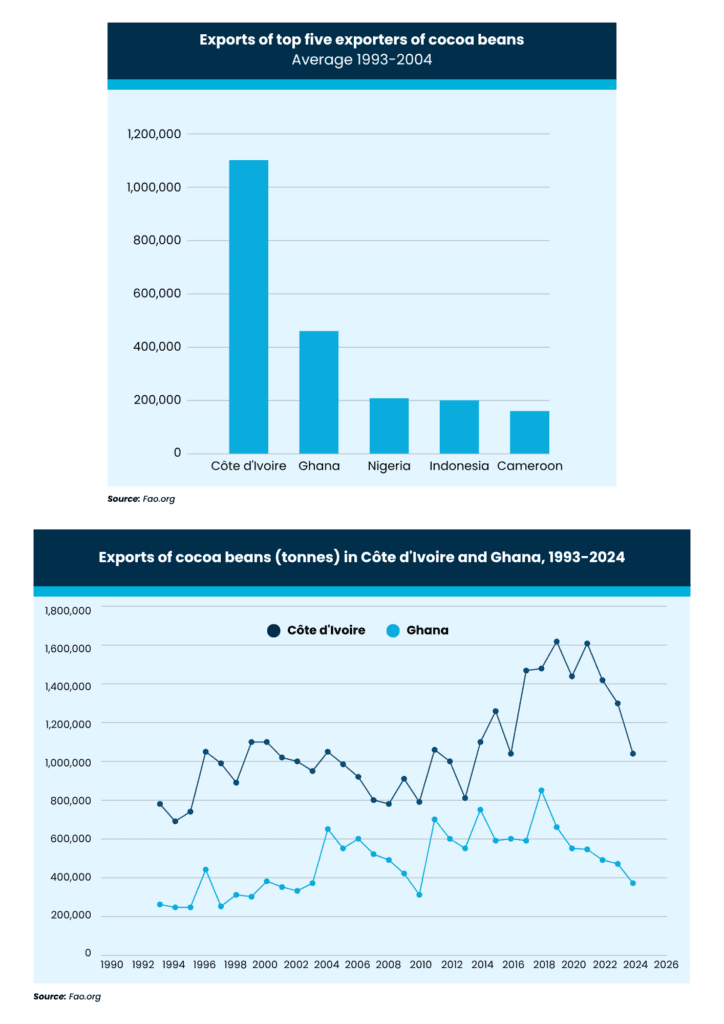
West Africa — primarily Côte d'Ivoire, Ghana, Nigeria, and Cameroon — accounts for roughly 70% of global cocoa production. Yet the farmers producing this crop operate in conditions that are strikingly at odds with the glossy sustainability commitments made by chocolate manufacturers and retailers in Europe and North America. Several interconnected crises are driving the sector toward a breaking point.
Falling Prices and Economic Vulnerability
The 70% drop in cocoa prices over the past year has devastated farm-level incomes at a time when input costs — fertilizers, labor, transport — have risen sharply due to broader inflationary pressures. Many smallholder farmers, who make up the overwhelming majority of cocoa growers in West Africa, are now selling their beans below the cost of production. This economic squeeze makes it nearly impossible to invest in better farming practices, farm maintenance, or sustainability initiatives — creating a vicious cycle where poverty and poor productivity reinforce each other.
Climate Change and Deforestation
Climate change poses one of the most severe long-term threats to West African cocoa. Rising temperatures, erratic rainfall, and prolonged dry seasons are already reducing yields and increasing the spread of crop diseases such as black pod and swollen shoot virus. In response, some farmers have expanded their plots into forested areas in search of more fertile land — accelerating the very deforestation that makes climate change worse. This creates another paradox: cocoa farming both suffers from and contributes to environmental degradation.
International regulators have taken notice. The European Union Deforestation Regulation (EUDR), which requires companies to prove their supply chains are free from deforestation, has added compliance pressure to an already strained system. While the intent is positive, the practical burden of meeting traceability requirements often falls disproportionately on small farmers who lack the resources or technical infrastructure to provide the documentation that international buyers now demand.
Smuggling and Market Distortions
Cocoa smuggling across West African borders is a persistent and underreported problem. In Ghana and Côte d'Ivoire, price differentials between official and informal markets incentivize farmers and intermediaries to move beans across borders illegally, undermining official export revenues and distorting production data. This makes it difficult for governments and international organizations to plan effective interventions and further weakens the ability of national cocoa boards to support farmers through pricing floors or social programs.
Financing Gaps and Storage Constraints
Access to finance remains a critical barrier for West African cocoa farmers. Without affordable credit, farmers cannot invest in better planting materials, irrigation, or post-harvest infrastructure. Storage constraints compound the problem: a lack of adequate facilities means that farmers are often forced to sell immediately after harvest when prices are at their lowest, rather than holding their stock to sell when market conditions improve. This structural disadvantage keeps farmers price-takers rather than price-makers in a global supply chain where the value is captured elsewhere.
What Experts Say Must Change
Despite the severity of these challenges, experts and industry observers point to concrete reforms that could reverse the trajectory of West African cocoa and create a more equitable, resilient sector.
Stronger Regional Cooperation
One of the most frequently cited solutions is deeper coordination between cocoa-producing nations. Rather than competing against each other for export revenues — which multinationals exploit to drive down prices — West African governments could collaborate to establish unified pricing floors, share agricultural research, and present a stronger negotiating front to global buyers. The model of OPEC, though imperfect, offers a loose template for how commodity-producing nations can use collective action to stabilize markets.
An African Cocoa Exchange
Experts argue that establishing a dedicated African cocoa exchange would be a transformative step toward market sovereignty. Currently, cocoa futures are priced and traded on exchanges in London and New York, with West African producers having virtually no influence over benchmark prices. A regional exchange would allow producers to participate more directly in price discovery, hedge against price volatility, and capture a greater share of the value chain closer to the point of production.
Improved Traceability and Digital Tools
Better traceability systems — powered by mobile technology, satellite mapping, and blockchain — can help farmers meet international compliance requirements while also demonstrating the sustainability of their practices. When farmers can prove the origin and environmental credentials of their cocoa, they become eligible for premium markets and fairer contracts. Investments in digital infrastructure at the farm level are therefore not just a compliance exercise but a pathway to greater economic inclusion.
The Stakes Are High
The sustainability paradox of West African cocoa will not resolve itself. Without meaningful structural reform — at the farm level, the national level, and the global policy level — the industry risks a collapse that would devastate millions of farming households while also threatening the long-term supply of cocoa that the global chocolate industry depends on. The good news is that the path forward is increasingly well-understood. The question is whether governments, corporations, and international institutions have the political will to walk it.
For consumers, the story of West African cocoa is a reminder that sustainability labels on chocolate bars represent a commitment that is still far from fully honored. Genuine progress will require more than certification schemes and corporate pledges — it will require systemic change in how one of the world's oldest and most beloved commodities is grown, traded, and valued.