
Bangladesh Moves to Fence Its Border With Myanmar: What's Driving the Decision?
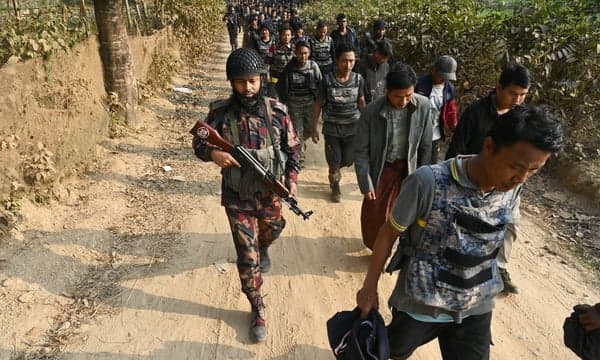
In recent years, the Bangladesh-Myanmar border has transformed from a manageable frontier into one of South Asia's most volatile security flashpoints. Stretching roughly 271 kilometers through dense jungle, river deltas, and hilly terrain, this border was already under immense strain from the Rohingya refugee crisis. Now, a new and deeply complicating factor has emerged: the Arakan Army, a powerful non-state armed group, has seized effective control of Myanmar's side of the border. In response, Bangladesh is accelerating plans to construct a physical fence along the entire boundary — a major strategic shift toward unilateral border management.
The Arakan Army: A Non-State Actor Reshaping the Border Equation
The Arakan Army (AA) is an ethnic armed organization representing the Rakhine people of Myanmar's Arakan (Rakhine) State. Since the February 2021 military coup in Myanmar, the country has descended into a multi-front civil war pitting the military junta against a coalition of resistance forces. The Arakan Army has emerged as one of the most effective of these groups, seizing vast swathes of territory in Rakhine State — including key towns, townships, and critically, long stretches of the border with Bangladesh.
This development fundamentally changes the security calculus for Dhaka. Traditionally, managing a shared border relies on bilateral mechanisms — joint patrols, hotlines between border guard forces, formal agreements, and diplomatic channels between two sovereign governments. When a non-state actor controls the other side, none of those mechanisms reliably function. The Myanmar Border Guard Police, which Bangladesh's Border Guard Bangladesh (BGB) would normally coordinate with, has been largely displaced. The Arakan Army, while politically organized, is not a recognized state entity and operates outside the frameworks of international border agreements.
Why Physical Fencing Is Now Bangladesh's Preferred Strategy
Faced with an interlocutor it cannot formally engage, Bangladesh has shifted toward unilateral tools of border management — and the most visible of these is physical fencing. The logic is straightforward: when you cannot rely on the other side to police its territory, you secure your own side instead.
Bangladesh's border fencing initiative aims to accomplish several overlapping security objectives:
- Stemming irregular migration: The collapse of security in Rakhine State has pushed fresh waves of Rohingya and other displaced people toward the Bangladesh border. Bangladesh, already hosting over 1.2 million Rohingya refugees in Cox's Bazar — the largest refugee settlement in the world — is deeply reluctant to absorb additional arrivals it cannot manage or repatriate.
- Controlling arms and drug trafficking: The border has long been a conduit for methamphetamine (yaba) tablets and small arms flowing from Myanmar into Bangladesh. With the Arakan Army consolidating control, the risk of armed groups using border zones as logistics corridors increases significantly.
- Preventing militant infiltration: Bangladesh has domestic security concerns about violent extremist groups potentially exploiting porous border areas as transit or sanctuary zones amid Myanmar's chaos.
- Asserting territorial integrity: Physical infrastructure signals sovereign presence and control in a region where the absence of a functional counterpart on the Myanmar side could otherwise create ambiguity about effective jurisdiction.
The Limits of Bilateral Border Management in Conflict Zones
Bangladesh's turn toward unilateralism reflects a broader global pattern. When civil war, state collapse, or insurgency destabilizes one side of a border, neighboring countries routinely find that existing diplomatic and cooperative frameworks become hollow. The bilateral agreements Bangladesh held with Myanmar's government — however imperfect — depended on Naypyidaw maintaining at least nominal authority over its borderlands. That assumption no longer holds for much of Rakhine State.
This is not the first time Bangladesh has faced this dilemma. The influx of Rohingya refugees following the 2017 military crackdown in Myanmar demonstrated how quickly cross-border crises can escalate when Myanmar's state institutions either fail or actively produce displacement. What is new now is the permanence of the change: the Arakan Army is not a temporary disruption. It appears to be consolidating a form of governance in areas it controls, raising the prospect that Bangladesh may be dealing with a de facto Arakan authority on its border for years, if not decades, regardless of how Myanmar's civil war eventually resolves.
Diplomatic Complications and Regional Implications
The fencing initiative is not without diplomatic sensitivity. Any large-scale border infrastructure project carries the risk of being read as a provocation, or of hardening divisions in ways that complicate future normalization. Bangladesh has maintained formal diplomatic relations with Myanmar's junta government in Naypyidaw, even as that government's writ over Rakhine State has effectively collapsed. Engaging the Arakan Army in any formal capacity, on the other hand, risks antagonizing Naypyidaw and potentially other regional powers, including China, which has its own complex relationships with both the junta and various ethnic armed organizations.
Regional bodies like ASEAN have proven largely ineffective at addressing Myanmar's crisis. This vacuum of multilateral action further pushes Bangladesh — and other Myanmar neighbors like India and Thailand — toward self-reliant, unilateral approaches.
What Comes Next for the Bangladesh-Myanmar Border?
The fence Bangladesh is building is ultimately a symptom of a deeper regional disorder. It buys time and provides a degree of control, but it does not resolve the underlying drivers of instability: Myanmar's civil war, the statelessness of the Rohingya people, and the governance vacuum in Rakhine State. A durable solution will eventually require political engagement — whether with Myanmar's future government, with the Arakan Army, or through a broader multilateral framework — that addresses the conditions pushing people across the border in the first place.
For now, however, Bangladesh has made a pragmatic calculation. When the state on the other side of your border is no longer effectively present, you build your fence and manage what you can control. It is a decision rooted in necessity, shaped by geography, and driven by a security environment that shows little sign of improving in the near term.