
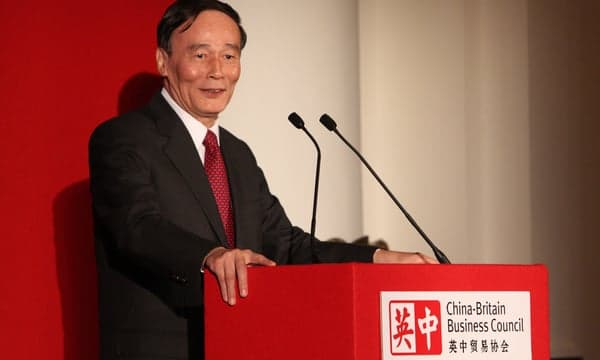
Xi Jinping's Purge Reaches Beyond the Military
When most observers talk about Xi Jinping's sweeping anti-corruption campaigns, the conversation tends to focus on the People's Liberation Army. Generals have been dismissed, defense ministers have disappeared, and entire procurement networks have been dismantled under the watchful eye of the Central Military Commission. But to focus only on the military is to miss a larger, perhaps more consequential story unfolding at the very top of the Chinese Communist Party. Xi Jinping has turned his sights on one of the most powerful civilian figures in recent Chinese political history: Wang Qishan, a former Politburo Standing Committee member and one-time economic czar whose influence once rivaled Xi's own.
This development signals something profound about the direction of Xi's leadership and the internal dynamics of the CCP. It is not merely a housecleaning exercise or a routine rotation of elites. It is a methodical, ruthless consolidation of power that leaves no faction, no seniority, and no past alliance untouched.
Who Is Wang Qishan?
To understand the significance of targeting Wang Qishan, one must first appreciate who he is within the architecture of Chinese Communist Party power. Wang served on the Politburo Standing Committee — the seven-member body that sits at the absolute apex of CCP authority — from 2012 to 2017. During that period, he was widely regarded as Xi Jinping's most trusted enforcer, leading the Central Commission for Discipline Inspection (CCDI), the party's feared anti-graft watchdog. It was Wang who wielded the hammer of Xi's first wave of anti-corruption campaigns, bringing down so-called "tigers and flies" — senior officials and low-level bureaucrats alike — in numbers that stunned international observers.
After stepping down from the Standing Committee due to age conventions, Wang was appointed Vice President of China in 2018, a largely ceremonial but symbolically weighty role. He was also Xi's key interlocutor with the United States, handling sensitive diplomatic negotiations during periods of intense trade tension. For years, Wang Qishan was not just an ally — he was seen as indispensable.
The Fall From Grace
That image of indispensability has now been shattered. Xi Jinping's moves against Wang Qishan represent a dramatic reversal, one that underlines a fundamental truth about politics under Xi: loyalty is transactional, and past service offers no permanent protection. Reports and signals emerging from within China's opaque political system suggest that Wang has become a target of investigation or at the very least severe political marginalization, with associates in his network facing formal scrutiny.
The specific allegations or charges — if any have been formally articulated — remain characteristically vague, as is typical in Chinese elite politics. The CCP rarely telegraphs its internal moves with the transparency that Western political systems demand. Instead, purges are signaled through the disappearance of associates, the silencing of sympathetic voices in state media, and the quiet cancellation of public appearances. Each of these signals has, at various points, surrounded Wang and figures linked to him.
What This Tells Us About Xi's Anti-Corruption Campaign
The extension of the purge to Wang Qishan's network reveals several critical things about how Xi Jinping is reshaping the CCP.
- No one is untouchable. If the man who ran Xi's anti-corruption drive can himself become a target, it sends an unmistakable message throughout the party hierarchy. Every official, regardless of rank or past service, understands that proximity to power is not the same as security.
- Factionalism is being systematically dismantled. Chinese politics has long been characterized by informal factions — networks of patronage and loyalty built over decades. Wang Qishan presided over one of the most formidable of these networks. By going after it, Xi is not just removing a potential rival; he is eliminating an alternative power center that could, in theory, constrain his authority.
- The anti-corruption campaign is a political instrument. Critics and scholars have long argued that Xi's anti-graft crusade, while genuine in some respects, is also a highly effective tool for removing political obstacles. The campaign against Wang's circle reinforces this interpretation. Anti-corruption is not merely law enforcement — it is governance and consolidation rolled into one.
- The timing matters. With China facing significant economic headwinds, including a prolonged property sector crisis, sluggish consumer demand, and mounting geopolitical pressures, Xi's internal purges suggest that political discipline and centralized control are being prioritized above all else.
Implications for China's Political Future
The targeting of Wang Qishan has implications that ripple far beyond the internal politics of the CCP. For foreign governments and international businesses that cultivated relationships with Wang during his years as a diplomatic and economic power broker, the message is unsettling: the interlocutors they relied upon may no longer hold sway, and the networks of influence they built may be actively toxic liabilities in Beijing today.
For analysts of Chinese politics, this episode reinforces the picture of a party system undergoing a fundamental structural transformation. The informal checks that once existed — the unwritten agreements among senior leaders, the respect for retirement-era immunity, the protection afforded by past loyalty — are being erased one by one. What is replacing them is a more personal, more centralized, and more unpredictable system organized around Xi Jinping's singular authority.
Conclusion: A Purge Without Precedent in the Reform Era
Xi Jinping's purge of senior party figures beyond the military, and particularly the targeting of someone of Wang Qishan's stature, marks a watershed moment in CCP history. It signals that the consolidation of power Xi has been building since 2012 has entered a more aggressive and comprehensive phase. No rank protects, no past service insulates, and no informal agreement endures. For anyone watching the evolution of Chinese political power, the lesson is stark: under Xi Jinping, the party belongs to one man, and that man is tightening his grip with every passing season.