
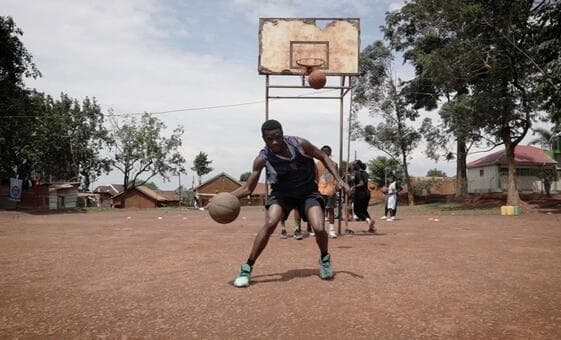
When a Basketball Court Becomes a Lifeline
For most teenagers, basketball is a pastime — a way to spend an afternoon, burn off energy, or bond with friends. But for 19-year-old Stephane Kulimushi, a young refugee living in Kampala, Uganda, the basketball court is something far more profound. It is a classroom, a community center, a sanctuary, and a stage for transformation. Every time Stephane steps onto the court to train the young refugees who look up to him, he is doing far more than teaching crossovers and layups. He is rebuilding hope, one dribble at a time.
Uganda hosts one of the largest refugee populations in Africa, with over 1.5 million displaced people seeking safety within its borders. Among them are thousands of young people like Stephane who have fled conflict, instability, and loss — carrying with them not just trauma, but extraordinary resilience. For these youth, access to structured activities, mentorship, and a sense of belonging can make an enormous difference in long-term wellbeing. That is precisely what Stephane has set out to provide through the power of sport.
A Young Leader Shaped by Displacement
Stephane Kulimushi understands displacement from the inside. Having experienced the disruption and uncertainty that comes with being forcibly uprooted, he knows what it means to arrive somewhere new without a clear sense of identity or purpose. Yet rather than allowing that experience to define his limitations, Stephane has channeled it into fuel for leadership. At just 19 years old, he has chosen to give back to a community that mirrors his own story.
His journey to becoming a youth basketball coach and mentor in Kampala is a testament to what can happen when a young person is given the right support and chooses to pay it forward. Stephane did not wait for an institution or a government program to solve the problems facing refugee youth in his community. He picked up a basketball and started showing up — day after day — because he believed sport could do what policies sometimes cannot: connect people, restore dignity, and build belonging.
Basketball as a Tool for Healing and Integration
Sport has long been recognized by humanitarian organizations as a powerful vehicle for psychosocial support. For children and young people who have experienced trauma, physical activity offers an immediate and accessible outlet for stress, anxiety, and grief. But the benefits extend well beyond the physical. Team sports in particular teach cooperation, communication, discipline, and trust — skills that are essential for rebuilding a sense of community after displacement.
On Stephane's court in Kampala, these lessons play out in real time. When he looks around at the players he trains, he sees more than athletes. He sees children who have survived impossible circumstances. He sees young people hungry for stability and structure. He sees peers who, like himself, are searching for a sense of identity in a world that has tried to strip it from them. Basketball gives them a framework — rules to follow, goals to chase, teammates to count on — and in doing so, it gives them back a small but vital piece of normalcy.
Building Community Across Borders
One of the most remarkable aspects of what Stephane is doing is its power to bridge divides. Uganda's refugee population is diverse, drawing from the Democratic Republic of Congo, South Sudan, Burundi, Somalia, and beyond. On the basketball court, those national and ethnic lines fade. Players who might otherwise have little reason to interact find themselves bound by a shared love of the game and the mutual trust that comes from competing side by side.
This kind of integration is not incidental — it is one of basketball's greatest gifts in a displacement context. Sport creates a neutral ground where young people can form relationships based on shared experience rather than conflict. Stephane, by fostering this environment, is quietly doing the work of peacebuilding and social cohesion that entire organizations strive to achieve.
The Wider Impact: Why Stories Like Stephane's Matter
It would be easy to view Stephane's work as a small, local effort — one teenager with a basketball making a difference in a single courtyard in Kampala. But stories like his carry a significance that ripples far beyond their immediate setting. They challenge the dominant narrative around refugees, which too often focuses exclusively on need, vulnerability, and dependency. Stephane's story reframes that narrative. He is not only a recipient of aid — he is an agent of change, a community builder, and a leader.
His example also highlights a critical and sometimes overlooked point: investment in refugee youth is never wasted. When young displaced people are given access to safe spaces, mentorship, and meaningful activity, they do not simply survive — they contribute. They organize. They inspire. They become exactly the kind of local leaders that communities need to heal and grow.
What Sport Can Teach the World About Resilience
Across the globe, sport is increasingly being used as a framework for refugee integration and youth development. Organizations like UNHCR, Right to Play, and numerous grassroots initiatives have documented the measurable positive effects of structured sports programs on the mental health, educational outcomes, and social development of displaced youth. Stephane's work aligns with and amplifies this body of evidence — not through reports or statistics, but through lived, human experience.
His story reminds us that resilience is not something that happens to people — it is something people build, often with whatever tools are available to them. For Stephane, that tool is a basketball. And in his hands, it is more than enough.
A Call to Support Youth-Led Initiatives in Refugee Communities
As Stephane continues his work on the courts of Kampala, the broader question becomes: how do we support more young people like him? The answer lies in recognizing and resourcing youth-led initiatives within refugee communities, providing access to sports facilities and equipment, and amplifying the voices of those who are already doing the quiet, daily work of rebuilding lives.
Donors, NGOs, governments, and individuals all have a role to play. Sometimes that role is as simple as listening — hearing the story of a 19-year-old with a basketball and understanding that inside it lives a model for something much larger: community, dignity, hope, and the enduring human capacity to turn pain into purpose.
Stephane Kulimushi looks around his basketball court in Kampala and sees more than players. Perhaps it is time the world looked at him and saw more than a refugee.