
How China's 'Red Lines' Are Quietly Shaping Global News Reporting
When a foreign correspondent files a story about Taiwan's government, or describes the situation in Xinjiang as a humanitarian crisis, or refers to the leaders of Tibet by their preferred titles, the words chosen are no longer just editorial decisions. Increasingly, they are political acts — ones that carry real professional and institutional consequences. Under Xi Jinping, the Chinese Communist Party (CCP) has extended its influence over political language far beyond China's borders, quietly reshaping how the world's media covers some of the most consequential stories of our time.
The Architecture of Influence
China's approach to controlling its global media image is not a single policy but an interlocking system of pressures, incentives, and punishments. At its most visible, it includes the expulsion of foreign journalists from Chinese soil, the denial of press credentials, and the blacklisting of news organizations deemed hostile to CCP interests. The United States and China have traded tit-for-tat restrictions on each other's journalists in recent years, but the asymmetry is stark: China operates one of the most restrictive media environments on earth, while using the openness of democratic media systems to project its own narratives outward.
Less visible — but arguably more consequential — is the quiet pressure applied to global media organizations through their economic exposure to China. Broadcasters, publishers, and digital platforms with advertising revenue, licensing agreements, or distribution deals in mainland China face a structurally uncomfortable choice: report freely and risk losing market access, or soften coverage and protect the bottom line. For publicly traded media conglomerates, that calculus is rarely spoken aloud, but it shapes decisions in boardrooms and editorial meetings nonetheless.
The Language of Compliance
One of the CCP's most effective tools is its insistence on specific terminology — and its punishment of outlets that deviate from approved phrasing. Taiwan must not be described as a country. Hong Kong's pro-democracy activists cannot be called freedom fighters. The events of June 4, 1989, in Tiananmen Square exist, in CCP-approved language, only as a "political incident" that was "handled correctly." Xinjiang's mass detention camps are "vocational training centers." Each of these linguistic prescriptions represents a red line: cross it, and consequences follow.
These consequences range from the withdrawal of press accreditation to the blocking of a publication's website in China, the expulsion of bureau staff, or coordinated harassment campaigns via Chinese state media and social platforms. For news organizations with correspondents operating inside China, the threat is particularly acute. A journalist's visa, and therefore their ability to report from one of the world's most important countries, can be revoked with little notice and no appeal.
Self-Censorship: The Invisible Censor
The most corrosive effect of this system may be the one that leaves the fewest traces: self-censorship. When reporters and editors know that certain framings, certain sources, or certain conclusions will draw official retaliation, the pressure to avoid them does not need to be formally applied. It becomes internalized — a professional instinct dressed up as editorial judgment.
Researchers who study media freedom have documented this phenomenon across a range of outlets and geographies. In newsrooms with significant exposure to the Chinese market, coverage of sensitive topics — Taiwan's sovereignty, the Dalai Lama, the origins of COVID-19, the treatment of Uyghur Muslims — tends to be measurably more cautious than in outlets with no such exposure. Stories are framed more narrowly. Sources critical of Beijing are quoted less prominently or not at all. The cumulative effect is a subtle but real distortion of the public record.
State Media and the Narrative Offensive
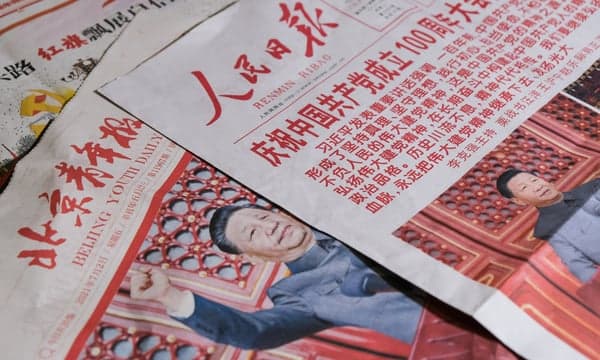
While applying pressure to independent outlets, the CCP has simultaneously invested heavily in projecting its own narratives globally. China Global Television Network (CGTN), China Radio International, the Global Times, and Xinhua operate in dozens of languages and reach audiences across every continent. Some of these outlets have purchased advertising space in major Western newspapers and broadcast networks, blurring the line between paid content and independent journalism.
Several democracies, including the United States, the United Kingdom, and Australia, have responded by requiring Chinese state media to register as foreign agents or foreign principals — a designation that triggers disclosure requirements and, in some cases, operational restrictions. But enforcement is uneven, and the volume of content produced by Chinese state media continues to grow.
Why This Matters for Democratic Societies
The pressure China exerts on global journalism is not simply a story about press freedom in an authoritarian state. It is a story about the integrity of the information environment in democracies. When editors in London, New York, or Sydney make coverage decisions influenced — however indirectly — by the preferences of a foreign government, the independence that gives journalism its social value is compromised.
- Voters in democratic countries rely on accurate, independent reporting to make informed decisions about trade policy, foreign alliances, and human rights commitments.
- Diplomatic and security communities depend on a free press to surface information that governments may wish to suppress.
- Civil society organizations use journalism to hold powerful actors, including foreign governments, accountable for their actions.
When that reporting is subtly shaped by the red lines of a rival power, the consequences extend well beyond any individual story or correspondent.
Navigating the Pressure
Some news organizations have responded with explicit policies designed to insulate editorial decisions from commercial or diplomatic pressure — ring-fencing their China coverage, publishing detailed editorial standards, and maintaining public commitments to specific terminology regardless of official objections. Investigative outlets with subscription-based funding models, less dependent on advertising or market access, have generally shown greater willingness to cross Beijing's red lines.
For the broader industry, however, the challenge remains largely unresolved. Training journalists to recognize and resist institutional pressure, establishing transparent standards for language and sourcing, and building economic models less vulnerable to authoritarian leverage are all long-term projects — and the pressure from Beijing shows no signs of easing.
Conclusion: Accuracy as a Form of Resistance
Journalism's foundational commitment is to describe the world as it is, not as powerful actors wish it to be described. Under Xi Jinping, the CCP has mounted one of the most sustained and sophisticated challenges to that commitment in the history of modern media. The red lines it draws are not merely about protecting a government's image — they are about controlling the terms in which reality itself is understood by billions of people. Recognizing that pressure, naming it clearly, and refusing to internalize it are among the most important things a free press can do. In that sense, accurate language is not just a professional standard. It is an act of democratic resistance.