
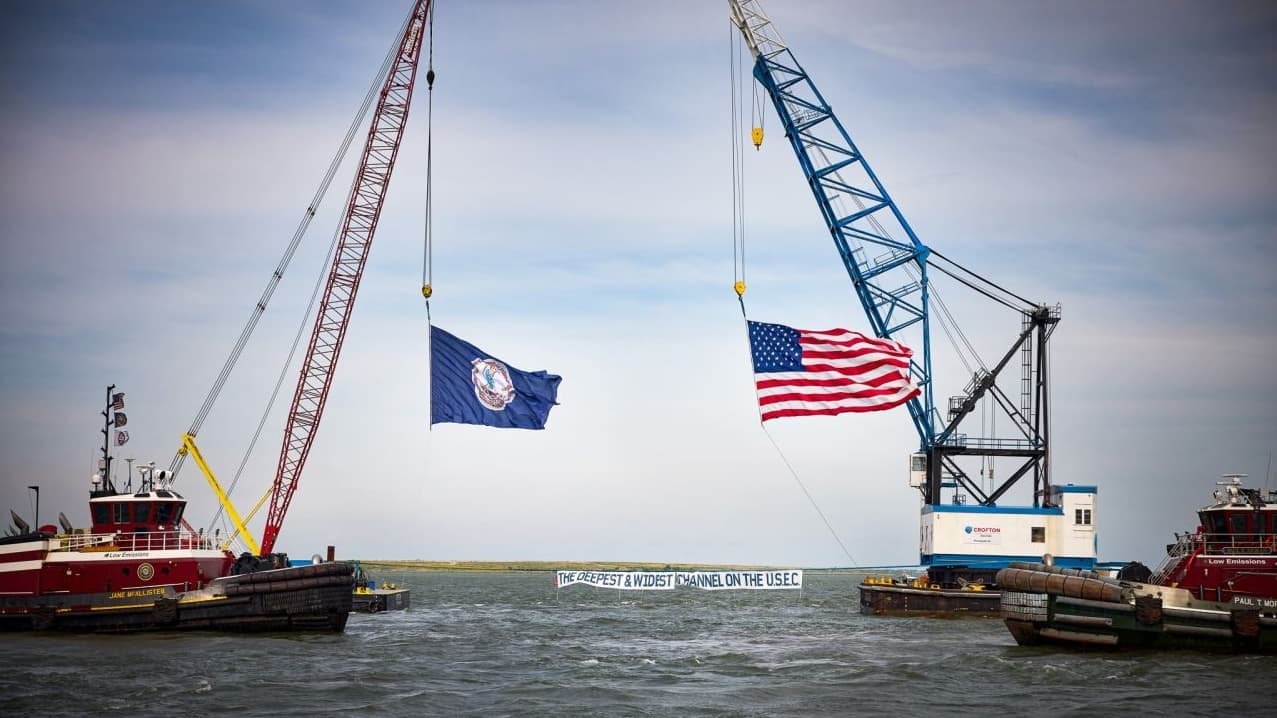
Port of Virginia Makes History with the Deepest Commercial Shipping Channel on the U.S. East Coast
In a landmark moment for American maritime infrastructure, the Port of Virginia has officially completed one of the most ambitious and consequential port development projects in recent U.S. history. With the inauguration of a $450 million harbor deepening and widening initiative, the port has cemented its position as home to the deepest commercial shipping channel on the entire U.S. East Coast. The milestone was celebrated before an audience of more than 200 guests at Norfolk International Terminals, with Virginia Governor Abigail Spanberger presiding over the event and declaring the port "wide open for business."
This is not merely a regional achievement. It is a transformative development for American trade, supply chain resilience, and the future competitiveness of East Coast ports in a global shipping landscape increasingly dominated by mega-vessels and ever-tightening delivery windows.
What the $450 Million Investment Actually Accomplished
The deepening and widening project reached substantial completion on February 28, and the results are immediately impactful. The newly deepened channel allows the largest cargo ships operating in the Atlantic trade to transit Norfolk Harbor carrying full loads — something that was simply not possible before. This distinction matters enormously in modern container shipping, where ultra-large container vessels (ULCVs) with capacities ranging from 14,500 to 24,000 twenty-foot equivalent units (TEUs) have become the dominant force in global trade.
Previously, even vessels that could physically enter the harbor were often forced to arrive partially loaded, sacrificing efficiency and driving up per-unit shipping costs. With the new channel depth now in place, those constraints are gone. Carriers can deploy their largest ships to Virginia fully laden, passing through with confidence and, critically, with the ability to do so in two directions simultaneously. The project also includes a widening component specifically engineered to allow two-way traffic for ULCVs — a feature that dramatically improves scheduling reliability and reduces bottlenecks at one of the nation's busiest ports.
Economic Benefits Extend Well Beyond the Waterfront
Governor Spanberger was emphatic in connecting the port's new capabilities to broader economic benefits throughout the Commonwealth of Virginia. The increased channel depth, she argued, directly facilitates higher export volumes for Virginia's robust agriculture and forestry sectors. Products such as soybeans, wood pulp, and lumber — staples of the state's export economy — can now move through the port with greater speed, lower shipping costs, and more predictable timelines.
For Virginia farmers, timber producers, and manufacturers, this is not an abstract infrastructure story. It translates into tangible competitive advantages in international markets. When shipping costs decrease and vessel reliability improves, exporters gain leverage. They can price their goods more competitively abroad, attract new international buyers, and reduce the logistical uncertainty that often plagues supply chains dependent on port congestion and vessel scheduling conflicts.
Beyond agriculture, manufacturers across Virginia stand to benefit from a port that can now offer greater efficiency for inbound components and outbound finished goods. In an era where supply chain disruptions have been a defining business challenge, the reliability dividend offered by a deeper, wider, more capable port channel carries significant long-term value.
The Gateway Investment Program: A Comprehensive Vision for Port Excellence
The $450 million channel project is not a standalone initiative. It is the flagship component of the Gateway Investment Program, a sweeping capital construction campaign launched in 2023 that encompasses multiple high-impact infrastructure upgrades designed to collectively elevate the Port of Virginia into a premier global gateway. Understanding the full scope of this program is essential to appreciating just how ambitious Virginia's port transformation truly is.
- $450 million harbor deepening and widening: Now complete, this project delivers the deepest commercial channel on the U.S. East Coast and enables two-way ULCV traffic through Norfolk Harbor.
- $83 million rail expansion: Already fully operational, this upgrade boosted the port's annual rail capacity to 2 million TEUs, strengthening the critical intermodal connections that allow cargo to move efficiently from ship to inland markets across the country.
- $220 million Portsmouth Marine Terminal conversion: The transformation of Portsmouth Marine Terminal into a deepwater heavy-lift facility adds a specialized capability to the port's portfolio, positioning Virginia to capture cargo types — including large industrial equipment and energy infrastructure components — that demand dedicated heavy-lift infrastructure.
- $650 million North Berth renovation at Norfolk International Terminals: This ongoing project is the largest single component of the Gateway Investment Program. Construction has now passed the halfway point, with completion projected for mid-2027. The renovation and reconfiguration of the North Berth will include four new low-profile ship-to-shore cranes and significant terminal modernization, further expanding the port's capacity and operational throughput.
Why This Matters for the Future of East Coast Shipping
The East Coast container market has grown increasingly competitive as carriers reassess their routing strategies in the wake of pandemic-era supply chain disruptions, Panama Canal capacity concerns, and shifting trade patterns. Ports that can accommodate the world's largest vessels — without restrictions on load capacity or transit direction — hold a significant structural advantage in attracting and retaining major shipping alliances and their cargo volumes.
The Port of Virginia has now positioned itself not just as a capable option, but as the deepest and arguably most future-ready gateway on the East Coast. When coupled with the rail expansion already delivering 2 million TEUs of annual capacity and the transformative North Berth project on the horizon, the port is building an end-to-end capability that few competitors on the Atlantic seaboard can match.
A Port Built for the Next Generation of Global Trade
The completion of the $450 million deepening project at the Port of Virginia marks more than an engineering achievement. It signals a clear and confident commitment to keeping American port infrastructure competitive with the world's leading cargo gateways. As container ships continue to grow in size and global trade volumes rise, the ports that invest today in depth, width, rail connectivity, and terminal modernization will be the ones that define the logistics landscape of tomorrow.
Virginia has made that investment. With the Gateway Investment Program well underway and the nation's deepest East Coast commercial shipping channel now open for business, the Port of Virginia is no longer simply keeping pace with the future of maritime trade — it is actively shaping it.