
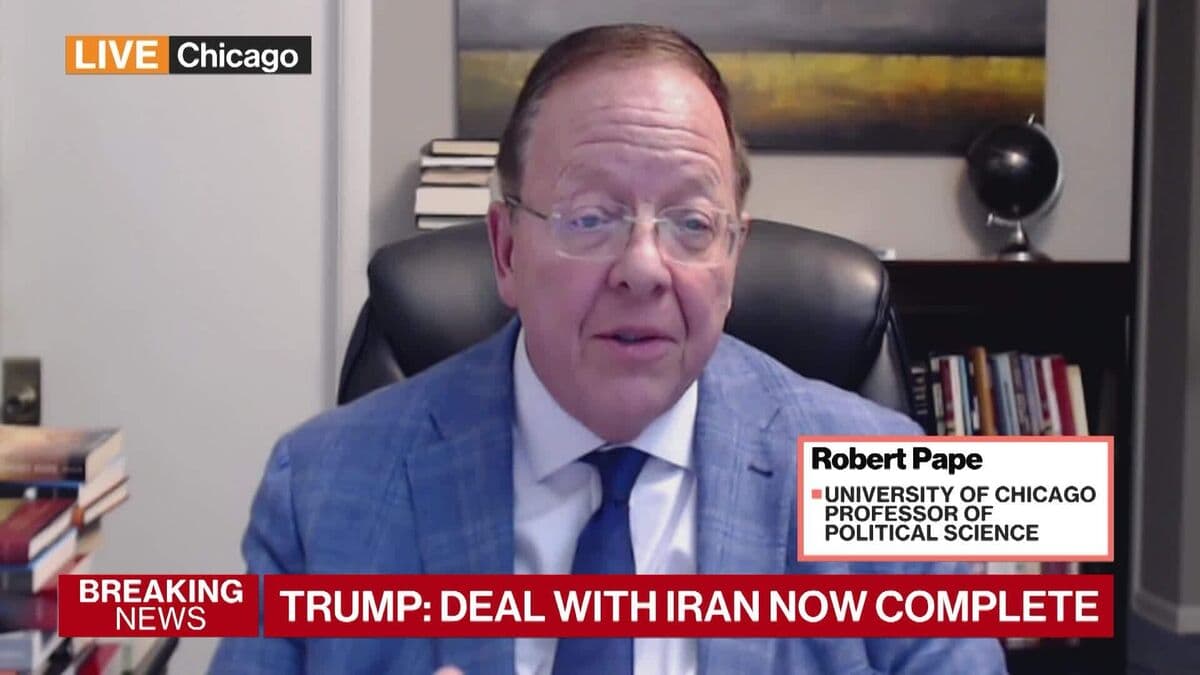
Iran's Leverage Isn't Going Anywhere: A Scholar's Take on the US-Iran Deal
As diplomatic channels between Washington and Tehran generate fresh headlines, one of America's most respected political scientists is urging the public not to get swept away by the optimism. Robert Pape, a professor of political science at the University of Chicago and a leading authority on international security and coercive strategy, delivered a sobering assessment of the emerging US-Iran deal during an appearance on Bloomberg's The China Show with hosts David Ingles and Yvonne Man. His message was clear: whatever framework is being negotiated, Iran's geopolitical leverage is not about to vanish — and the troubling absence of concrete details from both sides is only adding fuel to an already volatile fire of uncertainty.
Who Is Robert Pape and Why His Opinion Matters
Robert Pape is not a casual commentator on foreign affairs. He is the founder and director of the Chicago Project on Security and Threats (CPOST) at the University of Chicago, and the author of landmark works on coercion, military strategy, and international relations. His academic research has shaped how policymakers and analysts think about the use of force, sanctions, and diplomacy in global conflict. When Pape speaks about a geopolitical negotiation of this magnitude, his analysis carries the weight of decades of rigorous academic inquiry combined with deep expertise in how nations exercise and maintain power on the world stage.
His appearance on Bloomberg's The China Show brought his insights to a wide international audience, particularly relevant given that China itself maintains significant economic and diplomatic ties with Iran and has a vested interest in the outcome of any US-Iran agreement.
Iran's Leverage: More Durable Than the Headlines Suggest
One of Pape's most pointed observations was that Iran's leverage — both regional and global — is not something that a single deal, no matter how carefully crafted, can simply erase. This is a nuanced but critically important point that often gets lost in the media celebration surrounding diplomatic breakthroughs.
Iran's leverage stems from several deeply entrenched realities:
- Regional influence: Tehran's relationships with proxy forces across the Middle East, including groups in Iraq, Syria, Lebanon, and Yemen, give it a long arm of influence that operates independently of any nuclear negotiations. These networks have been built over decades and do not dissolve with the signing of a document.
- Energy geopolitics: Iran sits atop some of the world's largest proven reserves of oil and natural gas. Its ability to affect oil supply — and, by extension, global energy prices — gives it structural leverage in the international system that no deal directly addresses.
- Nuclear knowledge: Even in a scenario where Iran agrees to roll back certain elements of its nuclear program, the scientific and technical knowledge accumulated by Iranian engineers and physicists cannot be uninvented. That latent capability remains a form of leverage in itself.
- Diplomatic positioning: Iran has increasingly aligned itself with major powers such as Russia and China, expanding its diplomatic portfolio and reducing the degree to which Western pressure alone can dictate its behavior.
Pape's warning, therefore, is not merely academic. It is a call for policymakers and the public alike to resist the temptation of viewing the deal as a comprehensive solution when it may, at best, be a temporary constraint on one dimension of Iranian power.
The Danger of Vague Details
Perhaps equally alarming in Pape's assessment is the lack of transparency surrounding the deal itself. Both the American and Iranian sides have been notably guarded about the specifics of what has been agreed to, what has been conceded, and what verification mechanisms — if any — will be put in place. This opacity is not a minor administrative oversight; it is a fundamental problem for anyone trying to evaluate whether the agreement represents genuine progress or a temporary diplomatic maneuver.
Historically, the devil in arms control and diplomatic agreements has always been in the details. The 2015 Joint Comprehensive Plan of Action (JCPOA), for instance, was extensively detailed — running to tens of thousands of words across technical annexes — and was still subject to fierce debate about its adequacy and enforceability. A deal with fewer details and less transparency invites even more uncertainty about what is actually being achieved and what each side believes they have committed to.
Pape's concern about the lack of detail reflects a broader anxiety among foreign policy scholars: that ambiguous agreements can be more destabilizing than no agreement at all, because they create mismatched expectations that can quickly collapse into crisis when tested by reality.
What This Means for Global Stability
The US-Iran relationship does not exist in isolation. Its ripple effects touch the broader Middle East, energy markets, the global nonproliferation regime, and the strategic calculations of powers like China, Russia, Israel, and Saudi Arabia. A deal that fails to durably constrain Iran's capabilities — or one that both sides interpret differently — has the potential to accelerate regional tensions rather than ease them.
For investors, policymakers, and international observers watching from afar, Pape's analysis is a reminder that diplomatic announcements and geopolitical reality are not always the same thing. The headlines may signal progress, but the underlying dynamics of power, leverage, and national interest evolve on a much longer timeline than any single negotiation.
The Bottom Line
Robert Pape's appearance on Bloomberg's The China Show served as an important counterweight to premature optimism about the US-Iran deal. His core argument — that Iran's leverage will persist regardless of what is agreed and that the lack of detail introduces dangerous uncertainty — is grounded in both historical precedent and strategic logic. As negotiations continue and more information (hopefully) emerges, his framework offers a valuable lens through which to assess whether any emerging agreement represents meaningful progress toward regional and global stability or simply the appearance of it.
For anyone seeking to understand the true significance of the US-Iran deal, the message from one of America's top political scientists is both straightforward and sobering: the deal may change what Iran does in the short term, but it will not change what Iran can do — and that distinction matters enormously.