
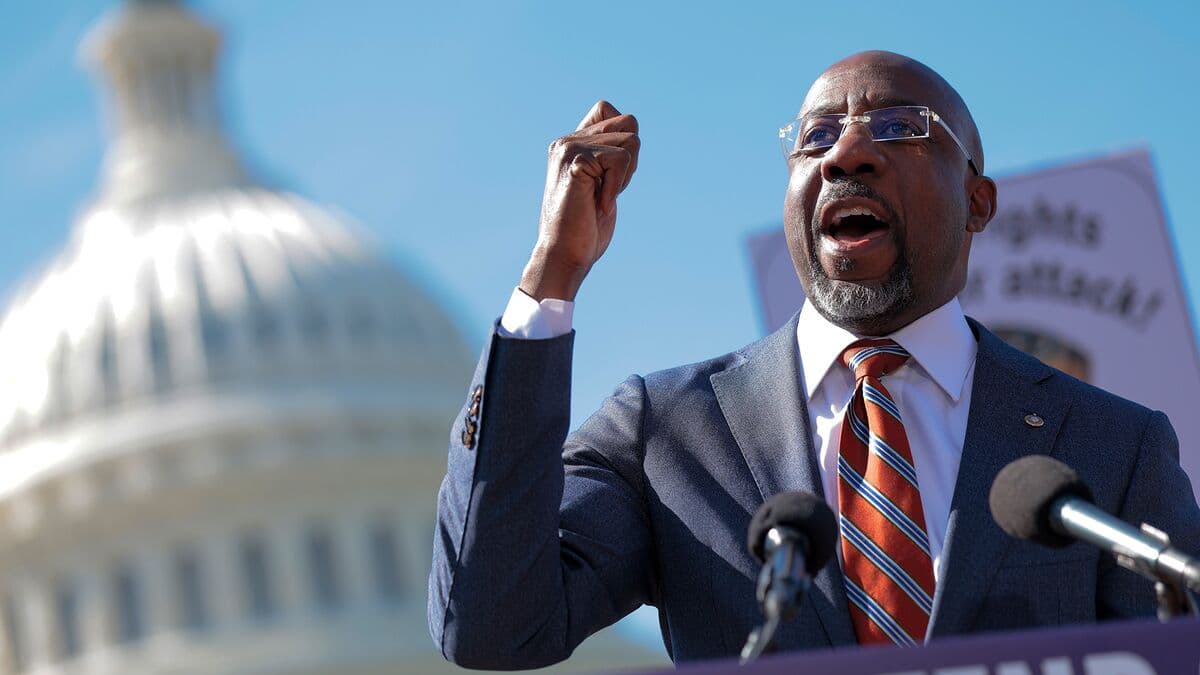
Senator Warnock Makes the Case for Main Street Over Wall Street
In a recent appearance on Bloomberg This Weekend, Senator Raphael Warnock (D-GA) delivered a pointed message to policymakers, investors, and everyday Americans alike: the true measure of this country's economic health is not found on a stock ticker. It is found on the sidewalks, storefronts, and streets of local communities across the United States. Speaking with host David Gura, Warnock argued that the national conversation around economic success has been too narrowly focused on Wall Street performance — and that this framing leaves millions of working Americans behind.
His comments arrive at a moment when the disconnect between financial markets and everyday economic reality has never felt more pronounced to ordinary citizens. While major stock indexes can post record-breaking gains, small business owners, working families, and local communities often tell a very different story.
What Does "Wall Street vs Main Street" Actually Mean?
The phrase "Wall Street vs Main Street" has been a staple of American political and economic discourse for decades, but it captures something very real about how economic prosperity is distributed in the United States. Wall Street, in its broadest sense, refers to the financial markets — the S&P 500, the Dow Jones Industrial Average, hedge funds, large institutional investors, and the corporations whose shares are publicly traded. When analysts say the economy is doing well, they often point to rising stock valuations, strong corporate earnings, and low volatility in financial markets.
Main Street, by contrast, represents the lived economic reality of most Americans. It is the corner diner, the family-owned hardware store, the local contractor, the nurse working overtime, and the college graduate struggling to repay student loans while paying rent. For these Americans, a bull market on Wall Street may be entirely invisible in their day-to-day lives.
Senator Warnock's central argument is that national economic policy — and the public discourse that shapes it — must center the Main Street experience rather than treating Wall Street metrics as the definitive barometer of whether the country is thriving.
Why the Gap Between Wall Street and Main Street Has Widened
Economic research has consistently shown that stock market ownership in the United States is heavily concentrated among the wealthiest households. According to data from the Federal Reserve, the top 10% of Americans by wealth own roughly 93% of all stocks. This means that when markets soar, the gains flow overwhelmingly to those who are already wealthy — while lower- and middle-income households experience little to no direct benefit.
Meanwhile, the pressures on Main Street have intensified in recent years. Small businesses have faced rising costs, supply chain disruptions, tightening credit conditions, and increasing competition from large retail and tech conglomerates. Many local communities have struggled to attract investment or retain young workers, leading to economic stagnation even as national GDP figures and corporate profits tell a rosier story.
- Small businesses employ nearly half of the American private-sector workforce, yet they often lack the political and financial capital that large corporations command.
- Wage growth for low- and middle-income workers has frequently lagged behind productivity gains and corporate profit margins.
- Local governments, which fund schools, roads, and public services, rely on the health of their local economies — not on the performance of financial markets.
- Communities of color, including many in Senator Warnock's home state of Georgia, have historically faced greater barriers to economic inclusion and are disproportionately affected when Main Street suffers.
Senator Warnock's Perspective and Legislative Focus
Throughout his time in the Senate, Raphael Warnock has been a consistent advocate for policies designed to lift up working families and small business owners. His appearance on Bloomberg This Weekend reinforced a philosophy that sees economic justice and community investment as inseparable from genuine national prosperity. For Warnock, a rising stock market that leaves Georgia's rural communities, small-town entrepreneurs, and working-class families behind is not a success story — it is a policy failure.
His remarks reflect a broader progressive critique of how economic success is measured and communicated. Rather than celebrating quarterly earnings reports or index fund performance as evidence that "the economy is strong," Warnock and like-minded policymakers argue that we should be asking harder questions: Can families afford their groceries and medical bills? Are small businesses able to secure affordable financing? Are wages keeping pace with the cost of living? Is homeownership still within reach for the middle class?
Rethinking How We Measure Economic Health
The conversation that Senator Warnock is pushing for is one that many economists and public intellectuals have also been advocating. Traditional metrics like GDP growth and stock market performance capture economic activity at an aggregate level, but they can obscure profound inequalities in how that activity is distributed. Alternative indicators — such as median household income, small business formation rates, local employment levels, and measures of economic mobility — often tell a more complete and honest story about whether communities are actually getting ahead.
Policies that directly support Main Street tend to include investments in affordable housing, small business lending programs, workforce development and job training, rural infrastructure, and broadening access to capital for minority-owned businesses. These are the kinds of concrete, community-level interventions that translate into tangible improvements in people's lives, even when they don't generate headlines on financial news networks.
The Bigger Political Conversation
Senator Warnock's interview on Bloomberg This Weekend is part of a two-part series, with the second installment providing further depth on his economic vision and policy priorities. His willingness to engage directly with a financial media audience on this topic is itself significant — it signals a push to reframe the economic debate on terms that prioritize people over portfolios.
As the United States continues to navigate questions about income inequality, the future of work, and the sustainability of local communities, the Wall Street vs Main Street debate is far from settled. What Senator Warnock's comments make clear is that for millions of Americans, the answer to the question "How is the economy doing?" depends entirely on which street you're standing on.