
Amazon Opens Its LTL Network — and Reveals a Critical Gap
Amazon made headlines this week by opening its less-than-truckload (LTL) network to all businesses, marking a significant expansion of its freight ambitions. But while the announcement rattled incumbent carriers enough to send their shares down roughly 5% on the day, the broader analyst consensus landed somewhere between cautious and reassuring for legacy players. The reason? Amazon's new LTL offering is a solid economy-tier product — but it is not yet the full-service, premium expedited network that would truly threaten the likes of Old Dominion or FedEx Freight. That gap, however, has a name: Forward Air.
What Amazon Actually Built
To understand why Forward Air matters, it helps to understand exactly what Amazon launched — and what it did not. Amazon's expanded LTL service is purpose-built for the cost-sensitive end of the freight market. The service covers shipments ranging from one to six pallets, or between 150 and 15,000 pounds, picked up and transferred through a nearby terminal before being delivered intact at competitive rates.
The network runs on an asset-light model, leveraging approximately 30 terminals that are woven into Amazon's existing package-delivery infrastructure. Coverage is strongest in the Eastern United States, with a growing footprint across Western metro areas. For shippers looking for a lower-cost alternative to legacy carriers on standard freight moves, Amazon's offering is a credible national entry from day one.
What it is not, however, is a premium expedited network. A full-scale national LTL carrier typically operates 200 to 300 service centers, reaching nearly every ZIP code in the country. FedEx Freight alone operates well over that threshold. Amazon currently has nowhere close to that density, and the asset-light model, while efficient, is structurally limited in how quickly it can scale to offer guaranteed expedited transit times across the entire continental United States.
The Expedited Tier Is the Missing Link
Premium expedited LTL is a distinct and highly profitable segment of the freight market. Shippers willing to pay a premium demand faster, more reliable transit times — often with defined service guarantees and specialized handling. This is not the commodity freight that Amazon's economy tier is designed to capture. It requires deeper terminal density, specialized linehaul networks, and a brand reputation built around speed and reliability rather than cost alone.
Without an expedited tier, Amazon's LTL network remains a strong but incomplete offering. It can compete aggressively for price-sensitive volume. It cannot yet serve the shipper who needs freight moving from Atlanta to Los Angeles with a guaranteed two-day transit and real accountability when things go wrong. That is the gap — and it is a meaningful one for any company positioning itself as a full-service freight provider.
Why Forward Air Is the Logical Answer
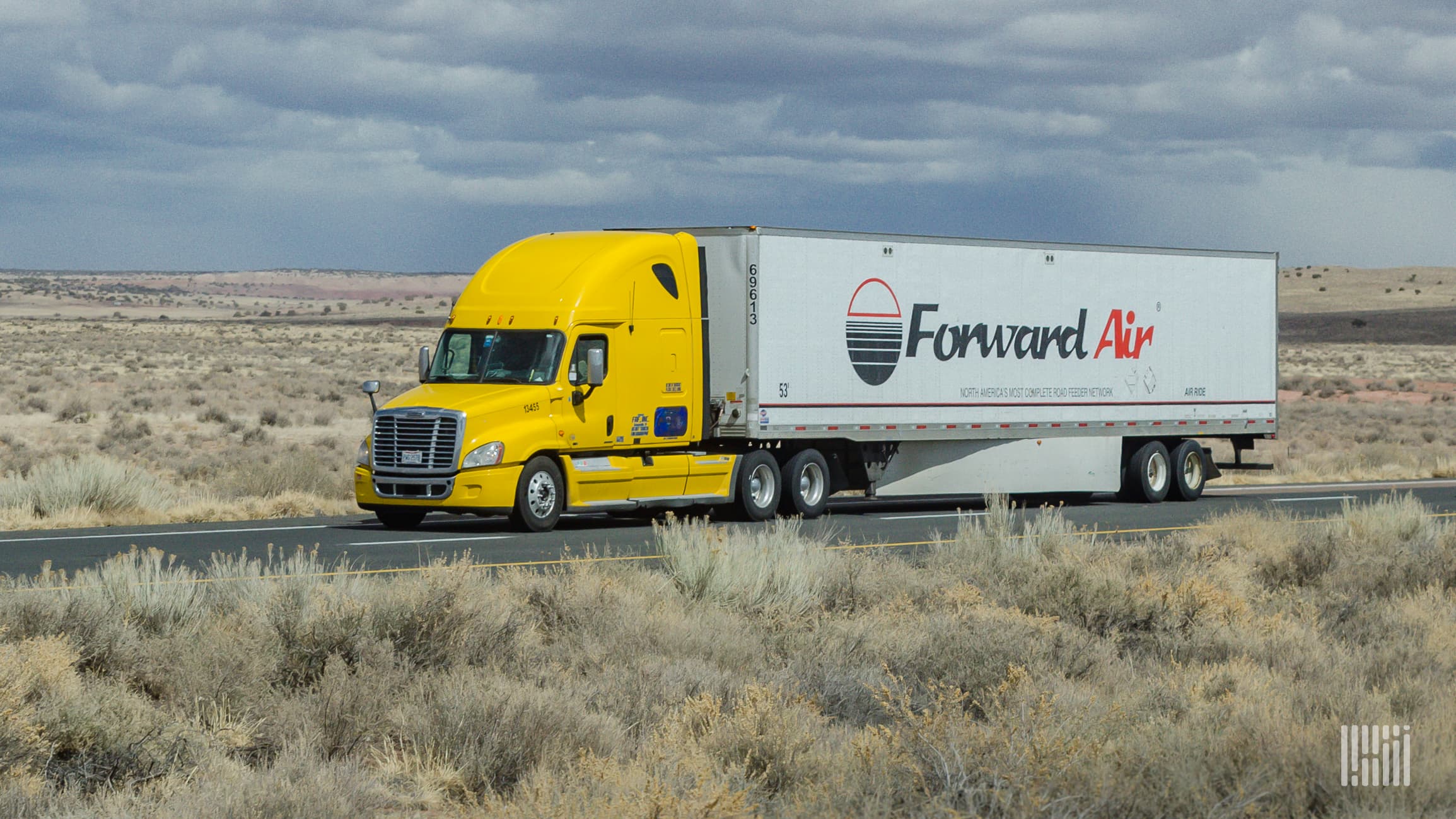
Forward Air was built for exactly the premium expedited LTL segment that Amazon lacks. The carrier made its name operating time-definite freight services, originally centered around airport-to-airport linehaul connecting major freight hubs. Over the years it expanded into a broader expedited LTL model that emphasizes speed and reliability over pure cost competition.
The timing could hardly be more aligned with Amazon's ambitions. Forward Air is currently in the middle of a strategic review, its equity is trading at a depressed valuation compared to historical norms, and the company has a motivated seller dynamic following a series of financial and operational challenges stemming from its acquisition of Omni Logistics. For an acquirer with Amazon's capital resources and logistics ambitions, these are favorable conditions.
An acquisition of Forward Air would give Amazon several things it cannot build quickly on its own:
- An established expedited linehaul network with real terminal density and proven transit time performance across the country.
- An experienced workforce and operational playbook for handling time-sensitive freight at scale.
- An immediate upgrade from economy-only LTL positioning to a tiered service model capable of competing across the full spectrum of freight demand.
- A recognized brand in the premium freight segment, reducing the market education cost that would come with building an expedited product from scratch.
What the Market Is Missing in Its Reaction
The muted market reaction to Amazon's LTL launch reflects an accurate read of where the network stands today. Analysts are correct that Amazon is not yet a hub-and-spoke carrier in the mold of Old Dominion or FedEx Freight. The incumbents have decades of terminal investment, route density, and customer relationships that cannot be replicated overnight.
But the market reaction may be underweighting what Amazon could do next. Amazon has a long history of entering a market at the economy end, establishing infrastructure and customer relationships, and then moving upmarket through acquisition or organic investment. The launch of its LTL network is best understood not as the destination but as the foundation. The economy tier is live. The expedited tier is the next logical step, and buying it is faster than building it.
The Strategic Case in Summary
Amazon now has a real national economy LTL platform. It does not yet have the premium expedited layer that would make it a complete competitor to the full-service incumbents. Forward Air is a premium expedited carrier, currently available at a depressed price, undergoing a strategic review that suggests its current owners are open to a transaction. The strategic fit is straightforward, the timing is favorable, and the acquisition would immediately close the most significant gap in Amazon's freight ambitions.
Whether Amazon moves on Forward Air or pursues another path to building out its expedited capabilities, the direction of travel is clear. The economy LTL launch is not the end of Amazon's freight story — it is the opening chapter. The carriers and shippers who treat it as the final move are likely to be caught off guard by what comes next.