
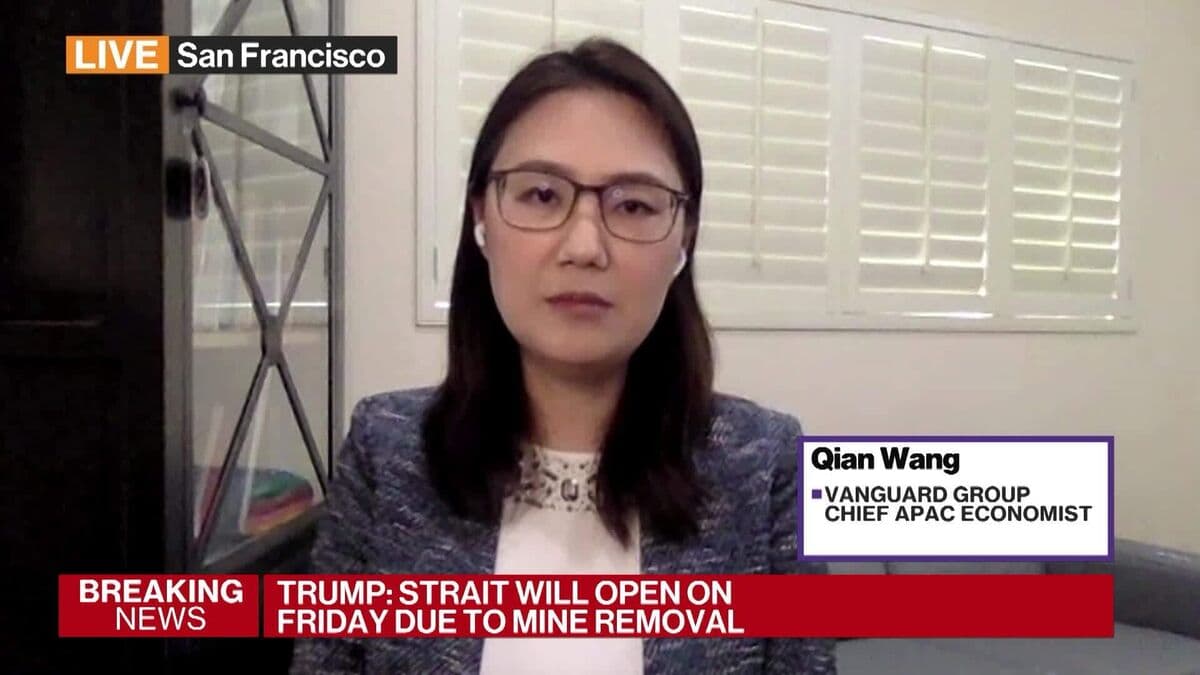
Vanguard's Chief APAC Economist Weighs In on the Iran-US Deal and Its Global Economic Implications
The financial world is watching closely as the United States and Iran have reached an agreement designed to halt the escalating threat of armed conflict between the two nations. While geopolitical developments of this magnitude are always complex and layered with uncertainty, economists and market strategists are already beginning to assess what this breakthrough could mean for global growth, energy markets, and investor sentiment. Among the voices offering early analysis is Qian Wang, Chief Asia-Pacific Economist at Vanguard Group, one of the world's largest asset management firms.
Speaking on Bloomberg's The Asia Trade with hosts Shery Ahn and Haidi Stroud Watts, Wang delivered a measured but cautiously optimistic assessment of the deal's potential economic ripple effects. Her perspective is particularly valuable given Vanguard's deep exposure to global markets and its mandate to think carefully about long-term macro trends that shape investment outcomes across asset classes and regions.
A Deal That Could Shift the Global Economic Outlook
At the heart of Wang's analysis is a straightforward but consequential observation: a reduction in geopolitical risk in the Middle East, even a partial one, carries meaningful upside for the global economy. Tensions between the United States and Iran have historically acted as a persistent drag on energy markets, supply chains, and regional trade flows. A credible move toward de-escalation, therefore, removes at least one layer of uncertainty that has weighed on forecasts and investor confidence alike.
Wang suggested that the deal, if it holds, could provide a modest but real boost to the global economic outlook. That kind of uplift matters in an environment where growth headwinds — from persistent inflation in some regions, to sluggish demand recovery in others — are already making policymakers and investors cautious. Any development that shifts the macro backdrop in a more constructive direction tends to have outsized psychological and market significance, even before its full structural effects are felt.
Significant Uncertainty Remains Over the Deal's Sustainability
However, Wang was careful not to overstate the case. She was quick to flag that significant uncertainty remains, particularly around how durable and sustainable the current agreement will prove to be over time. This is not a minor caveat. The history of diplomatic breakthroughs in the Middle East is littered with deals that unraveled, frameworks that were abandoned, and agreements that failed to translate into lasting stability on the ground.
For investors and economists, this uncertainty matters enormously. A deal that holds for months and leads to normalized trade flows, restored diplomatic channels, and reduced military posturing is a very different scenario from one that collapses within weeks and triggers a new round of escalating tensions. Wang's hedged language reflects the reality that markets may be pricing in optimism that has not yet been earned by the underlying facts on the ground.
This kind of careful, conditional framing is precisely what sophisticated institutional investors need to hear. It avoids the trap of either dismissing the deal's potential significance or overhyping a development that still carries substantial execution and political risk on both sides.
Energy Markets and Oil Prices: The Most Direct Economic Channel
One of the most immediate and tangible channels through which an Iran-US deal affects the global economy is energy. Iran holds some of the largest proven oil and natural gas reserves in the world. Years of sanctions and geopolitical isolation have kept a significant portion of that supply constrained or locked out of international markets. A genuine and sustained easing of tensions — particularly one that leads to a rollback of sanctions — could bring additional Iranian oil supply onto global markets.
For oil-importing economies across Asia and Europe, this would represent welcome relief. Lower or more stable energy prices ease inflationary pressures, improve trade balances, and free up consumer spending power that would otherwise go toward fuel costs. For central banks still navigating the aftermath of inflation cycles, a constructive move in energy prices is a meaningful tailwind.
Conversely, oil-exporting nations and energy sector investors would need to recalibrate expectations around price levels and supply dynamics. The net global impact, however, leans positive, particularly for the broad-based economic growth that Vanguard and other large asset managers rely on to generate returns across diversified portfolios.
Implications for Asia-Pacific Markets and Investment Sentiment
As Chief APAC Economist, Wang's framing naturally extends to what the deal means for the Asia-Pacific region specifically. Asia is disproportionately dependent on Middle Eastern energy imports, making it more sensitive than most to shifts in regional stability and oil supply dynamics. Countries like Japan, South Korea, India, and China are among the world's largest crude oil importers, and any stabilization of the Gulf region tends to feed through quickly into their trade accounts and macroeconomic conditions.
Beyond energy, de-escalation in the Middle East also improves the general risk environment that underpins capital flows and investor appetite across emerging and developed market Asia. When geopolitical tail risks fade — even modestly — risk assets tend to benefit, equity valuations improve, and cross-border investment activity picks up. For APAC markets that have been navigating their own set of domestic and regional challenges, a more benign external backdrop is a constructive development.
A Cautiously Positive Signal in a Complex Macro Environment
Qian Wang's analysis of the Iran-US deal reflects the kind of disciplined, evidence-based thinking that institutional economists bring to fast-moving geopolitical events. The deal represents a genuinely positive development for the global economic outlook — potentially lowering energy costs, reducing geopolitical risk premiums, and improving the conditions for trade and investment across multiple regions. At the same time, the sustainability of the agreement remains an open question, and markets would be wise to calibrate their optimism accordingly.
As more details emerge and the deal's durability is tested in the weeks and months ahead, economists like Wang will continue to provide the kind of nuanced, data-grounded perspective that helps investors navigate uncertainty without overreacting to either positive or negative headlines. For now, the signal is cautiously constructive — and in today's global macro environment, that is worth taking seriously.